
Professional Bird Protection Solar Panels: What Every Installer Should Know
Updated: Apr 10
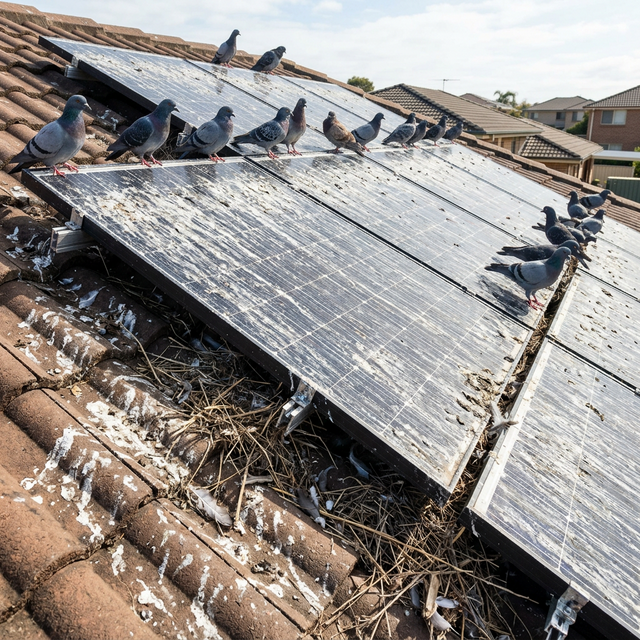
Professional bird protection solar panels — As rooftop solar installations continue to expand across Europe, a serious but often overlooked safety hazard is emerging: the fire risk created by bird nesting beneath photovoltaic modules.
This is not a single-event failure. It is a cumulative risk one that builds silently over successive nesting seasons as organic debris accumulates, cables are gradually damaged, and ventilation is progressively restricted. By the time the hazard becomes visible during an inspection, the conditions for a DC arc fault ignition may already be well established.
This article examines the three mechanisms through which bird nesting creates fire risk in PV systems, explains why the danger compounds over time, and outlines the practical steps installers and system owners can take to prevent it.
Professional Bird Protection Solar Panels: How Bird Nesting Creates Fire Risk
The fire hazard from bird nesting beneath solar panels is not caused by a single factor. It results from the interaction of three conditions that develop simultaneously in an unprotected PV array.
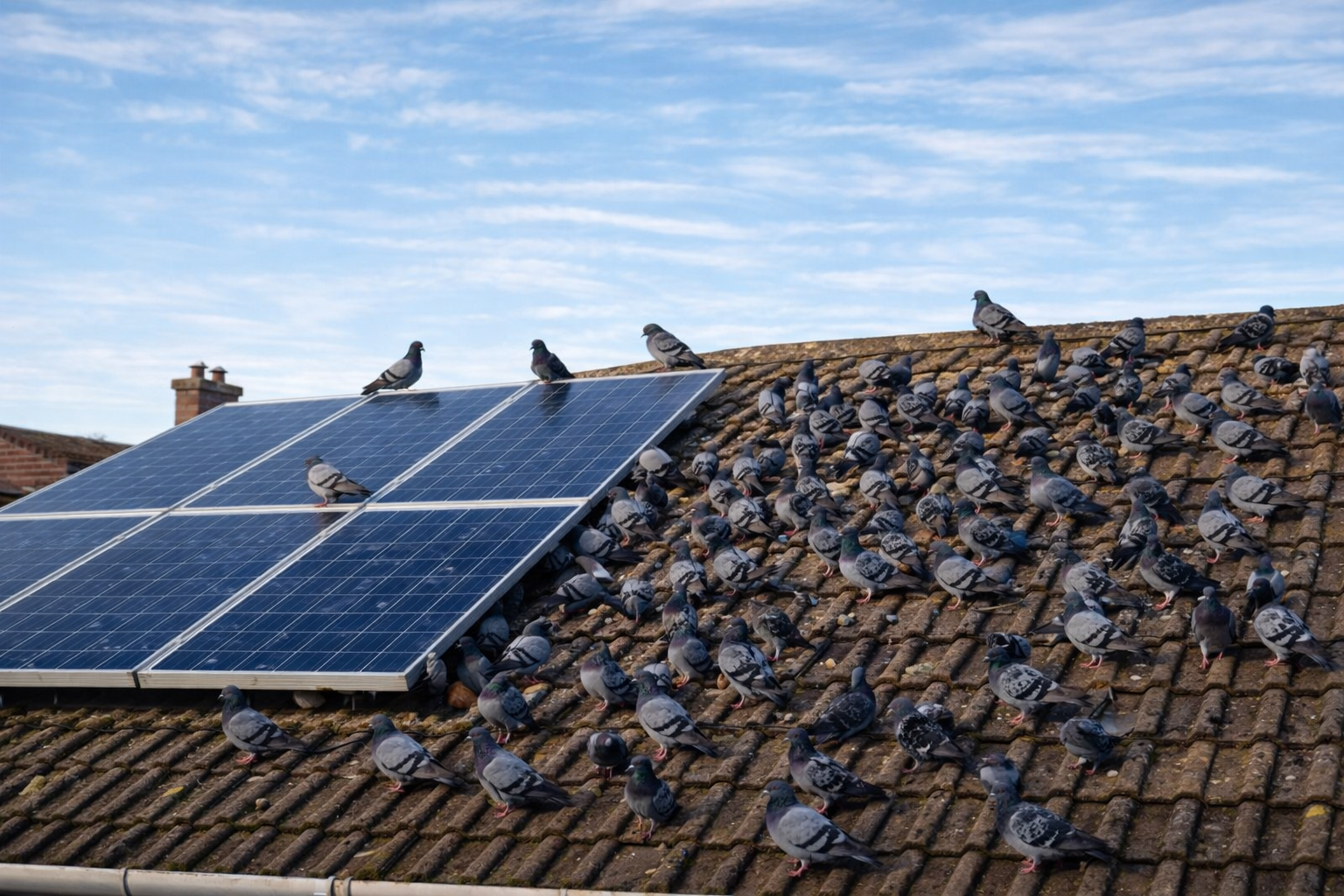
Flammable Nesting Material in a Confined Space
Pigeons and other urban birds build nests from dry straw, twigs, paper, textile fragments, and other organic debris. This material accumulates in the warm, sheltered cavity between the PV modules and the roof surface a space with limited natural ventilation and direct thermal exposure from the module backsheet.
During summer operation, module backsheet temperatures routinely reach 55-65°C and can exceed 70°C in high-irradiance conditions. Dry organic material in sustained contact with these temperatures becomes progressively more combustible. Over multiple nesting seasons, the volume of debris can reach several kilograms per system creating a significant fuel load in direct proximity to electrical components.
DC Cable and Connector Damage
Birds particularly pigeons and corvids peck at cable sheathing, MC4 connector housings, cable ties, and conduit fittings. This behaviour is driven by nest-building instinct and territorial activity, and it targets the most vulnerable components of the DC wiring system.
Over one or two nesting seasons, repeated pecking creates visible abrasion of cable insulation. In more advanced cases, the sheathing is breached entirely, exposing the copper conductor beneath. DC cables in residential PV systems typically carry 30-50 V per module, and series-connected strings can produce 300-600 V DC at the array level. When damaged insulation allows conductors to arc either to a grounded frame, an adjacent cable, or through carbonised debris the resulting DC arc fault generates sustained temperatures exceeding 3,000°C.
A DC arc fault is fundamentally different from an AC short circuit. It does not trip a conventional circuit breaker. It sustains itself as long as the PV modules are generating voltage which, during daylight hours, cannot be interrupted without physically disconnecting the array. This makes DC arc faults particularly dangerous in rooftop installations where nesting material provides an immediate and abundant fuel source.
Blocked Ventilation and Elevated Operating Temperatures
The natural airflow beneath PV modules serves a critical thermal management function. It dissipates heat from the module backsheet, helping to maintain operating temperatures within the design envelope and protecting cable insulation and connector materials from accelerated thermal degradation.
When nesting material blocks this airflow, operating temperatures rise. Cable insulation ages faster. Connector seals degrade. And the accumulated organic debris is subjected to even higher sustained temperatures further reducing its ignition threshold.
This creates a feedback loop: blocked ventilation raises temperatures, which accelerates cable degradation, which increases arc fault probability, while simultaneously making the surrounding nesting material more combustible.
Why This Risk Is Cumulative
Unlike a manufacturing defect or an installation error which are typically present from day one and can be identified during commissioning bird-related fire risk develops gradually and invisibly.
Each nesting season adds material to the cavity. Each year of bird activity further weakens cable sheathing. Each summer of elevated operating temperatures further dries and degrades the accumulated debris. The risk is not static it compunds.
A system that passes a visual inspection in year one may develop significant fire risk by year three or four if bird activity is present and unaddressed. This is particularly problematic because most residential PV systems are not subject to regular professional inspection. The hazard can develop entirely unnoticed until a fault occurs.
Timeline of Risk Development
In the first year, an initial nest is established. A small volume of debris accumulates around cable runs. Minor surface abrasion may appear on cable sheathing, but no functional damage is present.
By year two, the nest is rebuilt and expanded. Multiple kilograms of dry material may now be present. Cable abrasion progresses. Ventilation is partially obstructed, and module operating temperatures begin to increase measurably.
By year three and beyond, extensive debris accumulation is common. Cable sheathing may be breached in one or more locations. Ventilation is significantly blocked. The combination of exposed conductors, dry fuel, and elevated temperatures creates the conditions for arc fault ignition.
Evidence from the Field
While comprehensive European statistics on bird-related PV fires are still developing, the pattern is increasingly recognised by insurers, fire investigators, and industry bodies.
Insurance claims data from several European markets shows a growing proportion of PV-related fire incidents where bird nesting material is identified as a contributing factor. Fire investigation reports have documented cases where the ignition source was traced to a DC arc fault at a point of cable damage consistent with bird pecking activity.
Industry organisations including Solar Energy UK and several German PV trade associations have begun highlighting bird nesting as a material fire risk factor in residential and small commercial PV installations. The German Fire Protection Association (GFPA) includes guidance on debris accumulation beneath PV modules as part of its fire prevention recommendations.
Prevention: The Case for Protection at Commissioning
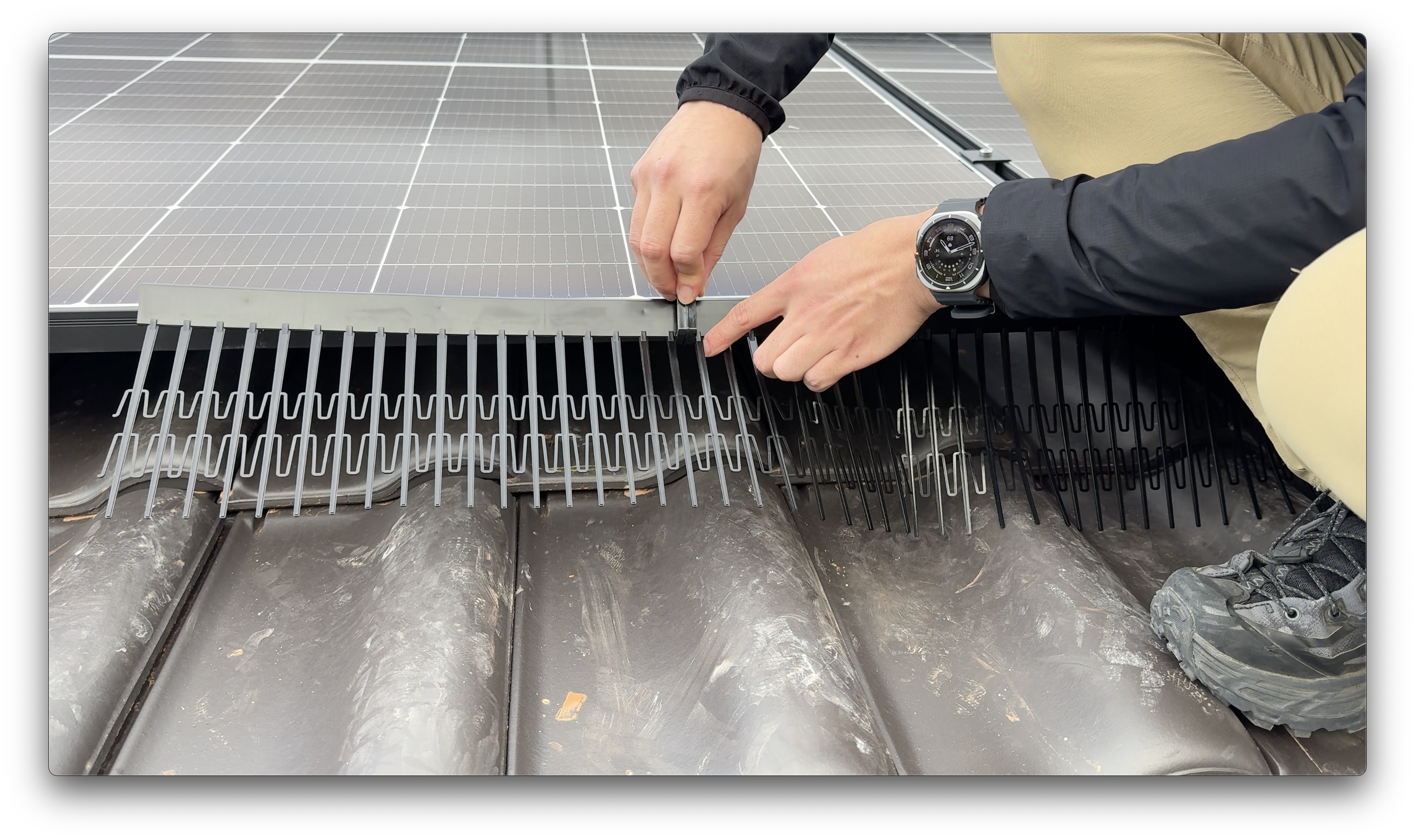
The most effective way to eliminate bird-related fire risk is to prevent nesting access at the point of installation. A clip-on mesh system such as PV Protector creates a physical barrier around the perimeter of the PV array, sealing the cavity beneath the modules without drilling, adhesive, or any modification that affects the module manufacturer's warranty.
Why Commissioning Is the Right Time
Fitting bird protection at commissioning when scaffolding is in place and the installer is already on the roof is significantly more cost-effective than retrofit. The additional time is typically 15-20 minutes. The material cost is a fraction of the total installation value. And the system is protected from the first day of operation, before any bird activity begins.
Why Reactive Inspection Is Not Sufficient
Some installers argue that regular inspection is an adequate alternative to proactive protection. In practice, this approach has significant limitations.
Most residential PV systems are not inspected annually. Even when inspections occur, the area beneath the modules is difficult to access and assess without partial removal of the array. And by the time cable damage is visible during an inspection, the risk may already be at a critical level.
Proactive protection eliminates the need to rely on inspection frequency, inspector thoroughness, or system owner diligence. It addresses the root cause nesting access rather than attempting to manage the symptoms.
Retrofit Protection for Existing Systems
For PV systems already in operation without bird protection, a retrofit programme should follow a structured sequence.
First, all nesting material and debris should be carefully removed from beneath the modules. This should be done by a qualified technician, as disturbing nests may also disturb electrical connections.
Second, a thorough visual inspection of all DC cable sheathing, MC4 connectors, cable ties, and conduit fittings should be conducted. Any evidence of abrasion, pecking damage, or insulation breach should be documented and repaired.
Third, where available, thermal imaging of the cable runs and connectors during system operation can identify hot spots that indicate degraded insulation or high-resistance connections.
Fourth, a clip-on mesh barrier should be fitted around the full perimeter of the array to prevent recolonisation. This step is essential without it, birds will return within days or weeks and the risk cycle begins again.
Conclusion
Bird nesting beneath photovoltaic systems is not merely a maintenance nuisance. It is a fire hazard one that develops gradually, compounds over time, and can remain invisible until a serious fault occurs.Conclusion — bird nesting fire risk solar panels In short, bird nesting fire risk solar panels is a
Conclusion—bird nesting fire risk solar panelshazard that grows over time.
The interaction of flammable nesting material, progressive DC cable damage, and blocked ventilation creates conditions that are uniquely favourable to arc fault ignition. And because DC arc faults cannot be interrupted by conventional circuit protection during daylight hours, the consequences of ignition in a debris-filled cavity can be severe.
The solution is straightforward and cost-effective: prevent nesting access at the point of installation with a professional clip-on mesh system. For existing systems, a structured retrofit combining debris removal, cable inspection, and mesh installation addresses both the immediate hazard and the long-term risk.
Bird protection is not an optional accessory. In any urban or suburban PV installation where pigeon populations are present, it is a fire safety measure and it should be treated as one.
Comments