
Solar Panel Inspect: How Often Should Solar Panels Be Inspected? A Practical Guide
- Mar 17
- 7 min read
Updated: Mar 28
Introduction- Solar Panel Inspection
Solar panel inspection frequency — Rooftop PV systems are designed to operate for 25 years or more with minimal intervention. This long design life, combined with the absence of moving parts, creates a common misconception: that solar panels require no maintenance or inspection at all.
In reality, every PV installation is exposed to a continuous combination of environmental stresses — UV radiation, thermal cycling, wind loading, moisture, soiling, and wildlife activity. These stresses affect cables, connectors, mounting hardware, and module surfaces gradually. Without periodic inspection, small developing faults go undetected until they cause measurable performance loss, safety hazards, or expensive component failures.
This article sets out a practical, tiered inspection framework for rooftop PV systems — appropriate for residential and small commercial installations — and explains how preventive protection measures reduce both the frequency and complexity of inspections over the system’s lifetime.
Why PV Systems Need Regular Inspection
The technical case for periodic inspection is well established. The IEC 62446-1 standard specifies requirements for PV system documentation, commissioning tests, and periodic verification. Most module and inverter manufacturers include inspection recommendations in their warranty documentation — and some explicitly condition warranty coverage on evidence of regular maintenance.
Beyond standards and warranties, the practical reasons are straightforward.
Gradual Performance Degradation
PV systems lose output capacity gradually. Module degradation accounts for approximately 0.5% per year under normal conditions. But additional losses from soiling, partial shading by debris, connector degradation, and cable damage can add another 5–15% over a period of two to five years — losses that are entirely recoverable if identified early through inspection.
Safety Risk Accumulation
The most serious safety risks in a PV system — DC arc faults, insulation failures, and fire hazards — develop progressively. A cable that begins with minor sheathing abrasion in year one can present an exposed conductor by year three. Without inspection, the first indication of the problem may be a thermal event rather than a maintenance report.
Bird and Wildlife Damage
In urban and suburban installations, bird nesting is one of the most common and consequential sources of system damage. Pigeons and other urban birds colonise the warm, sheltered cavity beneath PV modules. Their nesting activity introduces debris, moisture, and direct mechanical damage to cables and connectors. Without inspection, nesting sites expand and compound the damage over successive seasons.
A Tiered Inspection Framework
Not every inspection requires a professional technician on the roof. A tiered approach allows system owners and installers to balance thoroughness with practicality and cost.
Level 1: Monthly Monitoring Review
The first level of inspection requires no site visit at all. It involves reviewing the system’s energy production data through the inverter monitoring platform or a third-party monitoring service.
The key indicators to watch are total energy yield compared to the same period in previous years, adjusted for irradiance and weather conditions. A sudden drop in output may indicate a component failure. A gradual decline — particularly one that diverges from expected seasonal patterns — may indicate developing issues such as soiling, shading, or connector degradation.
Monthly monitoring review takes five to ten minutes and costs nothing beyond the monitoring platform subscription. It is the most cost-effective form of PV system oversight.
Level 2: Semi-Annual Visual Check
Twice per year — ideally in spring and autumn — a ground-level visual inspection should be conducted. This does not require roof access or specialised equipment.
From ground level, look for heavy soiling or staining on module surfaces, visible debris accumulation at the array edges, signs of bird activity such as droppings on or around the array, physical damage to visible cables or components, and any change in the array’s physical appearance compared to previous inspections.
The spring check is particularly important in regions with active pigeon or corvid populations. Birds that nested during winter may have left debris that is not visible from monitoring data alone. The autumn check prepares the system for winter conditions and identifies any issues from the summer operating period.
Level 3: Annual Professional Inspection
Once per year, a qualified installer or O&M technician should conduct a roof-level inspection. This is the most important regular maintenance activity for any PV system.
The annual inspection should cover module surface condition, including micro-cracks, delamination, discolouration, and hot spot indicators. It should verify cable routing and securing, confirming that cables remain properly supported and that no abrasion or UV degradation has occurred. All visible MC4 connectors should be checked for discolouration, cracking, or signs of thermal stress.
The mounting system should be inspected for corrosion, loosened fasteners, and structural movement. The under-panel cavity should be examined for bird nesting material, debris accumulation, moisture damage, or signs of wildlife activity.
The inverter and associated switchgear should be checked for error codes, warning indicators, fan operation, and general condition.
An annual professional inspection typically takes one to two hours for a residential system and provides the most comprehensive view of system health available without electrical testing equipment.
Level 4: Comprehensive Electrical Testing (Every 3–5 Years)
At intervals of three to five years, a comprehensive electrical verification should be performed. This goes beyond visual inspection to measure the system’s electrical parameters against its commissioning baseline.
Key tests include insulation resistance measurement on all DC cables, string open-circuit voltage comparison to identify underperforming strings, string short-circuit current measurement under known irradiance conditions, earth continuity and bonding verification, and thermal imaging of the array under load to identify hot spots, high-resistance connections, and bypass diode failures.
This level of testing requires specialised equipment and a qualified technician. It provides the most detailed diagnostic data and is particularly valuable for systems older than five years, systems that have experienced known environmental stress events, or systems where monitoring data suggests a developing fault that visual inspection has not identified.
The Under-Panel Cavity: The Most Overlooked Inspection Area
Across all inspection levels, the under-panel cavity is consistently the most neglected area. There are practical reasons for this: it is difficult to access, difficult to see into without removing modules, and easy to dismiss as a cosmetic concern rather than a technical one.
In reality, the under-panel cavity is where the most consequential damage to a PV system typically develops. Bird nesting introduces dry organic material — straw, twigs, feathers, paper — that traps moisture against cables and connectors, accelerating insulation degradation. This material also creates a combustible fuel load in direct proximity to high-voltage DC connections.
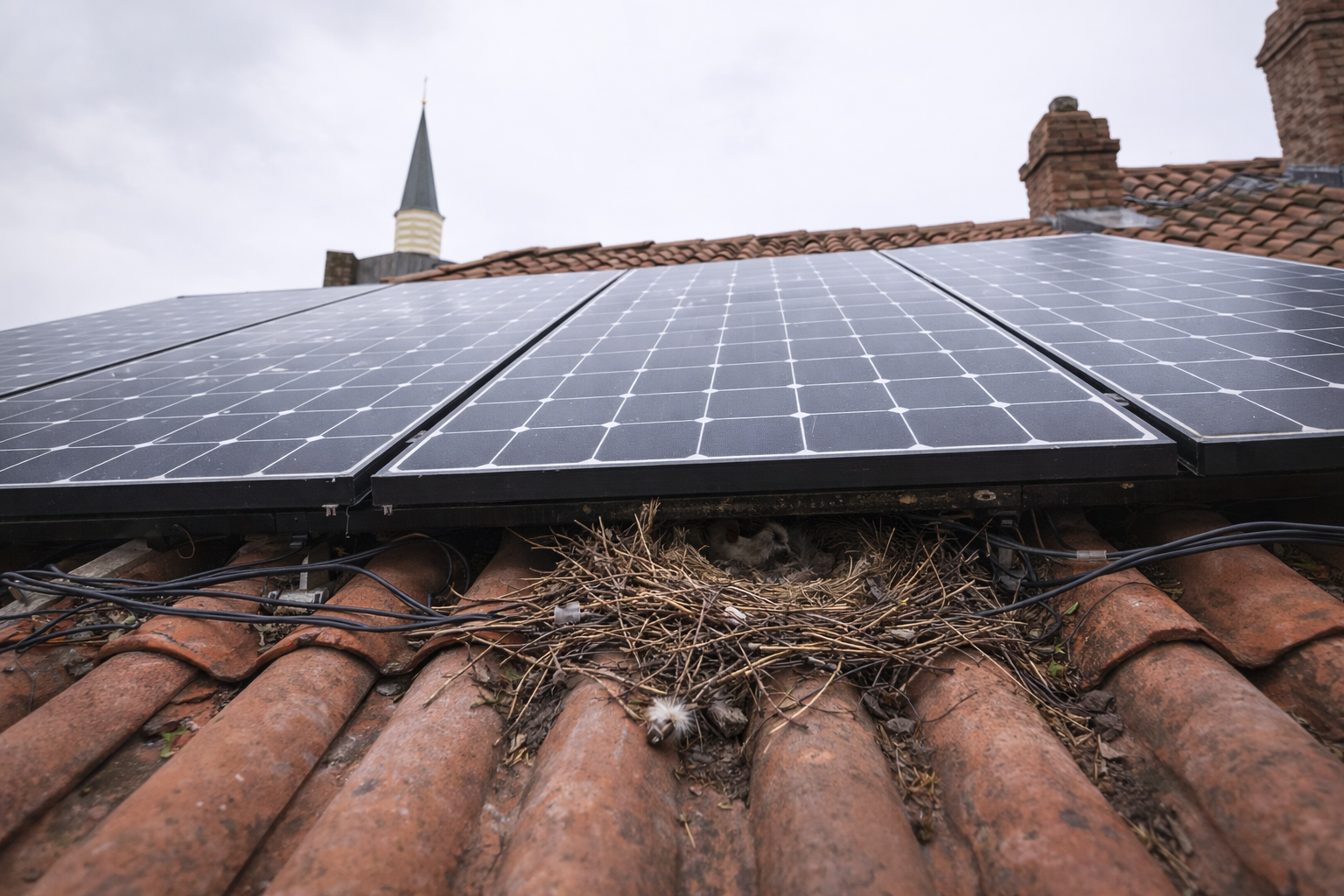
Bird pecking targets cable sheathing and connector housings specifically. Over one or two nesting seasons, this activity can breach cable insulation and create the preconditions for an arc fault. Bird droppings contain uric acid, which is mildly corrosive to cable sheathing and connector materials over sustained contact periods.
The challenge for inspection-based maintenance is that by the time bird damage is identified during an annual inspection, the damage has already been accumulating for months. Nest removal and cable repair are reactive measures — they address the symptoms but not the cause.
How Preventive Protection Reduces Inspection Complexity
The most effective way to reduce the long-term inspection burden on a PV system is to prevent the most common source of damage at the point of commissioning.
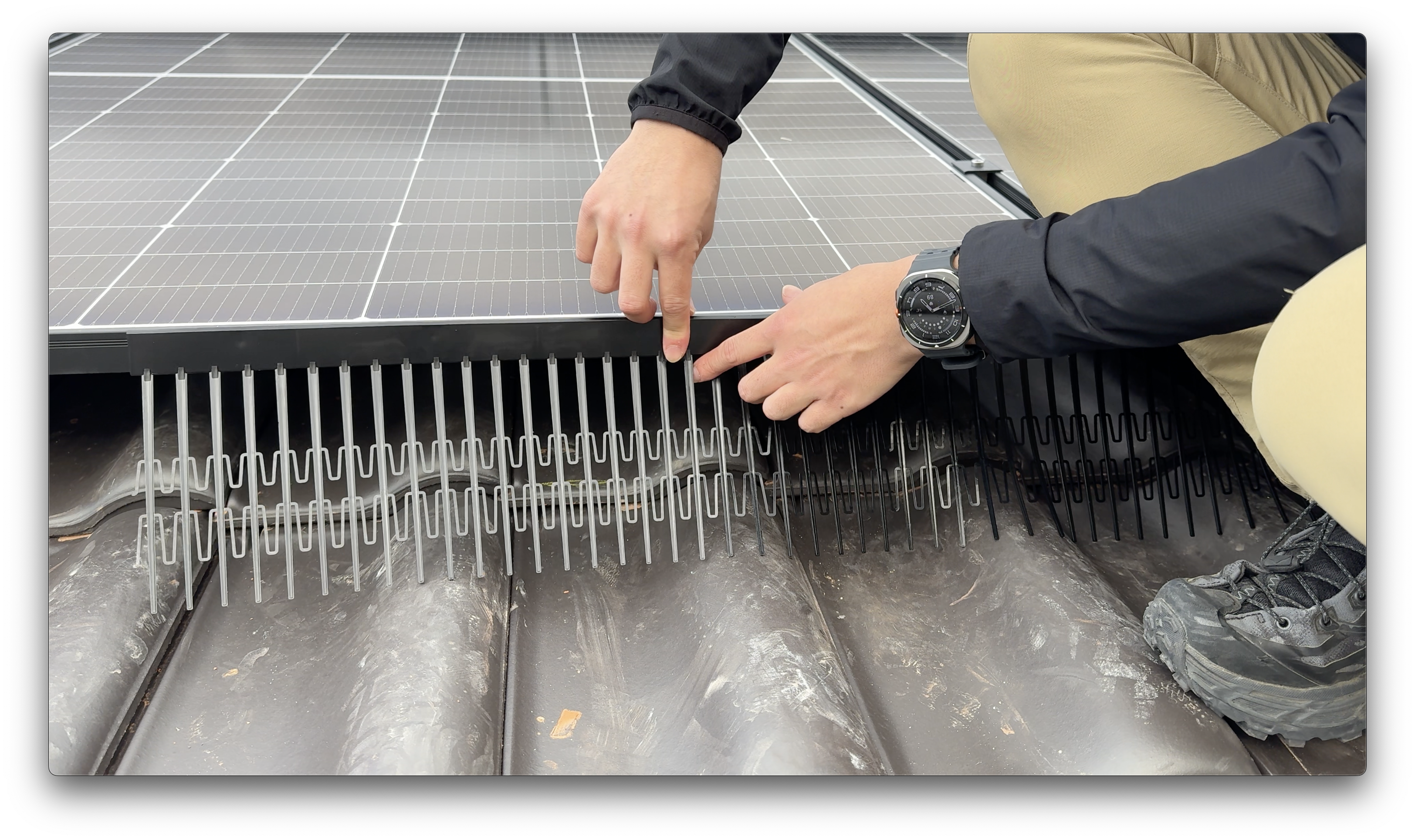
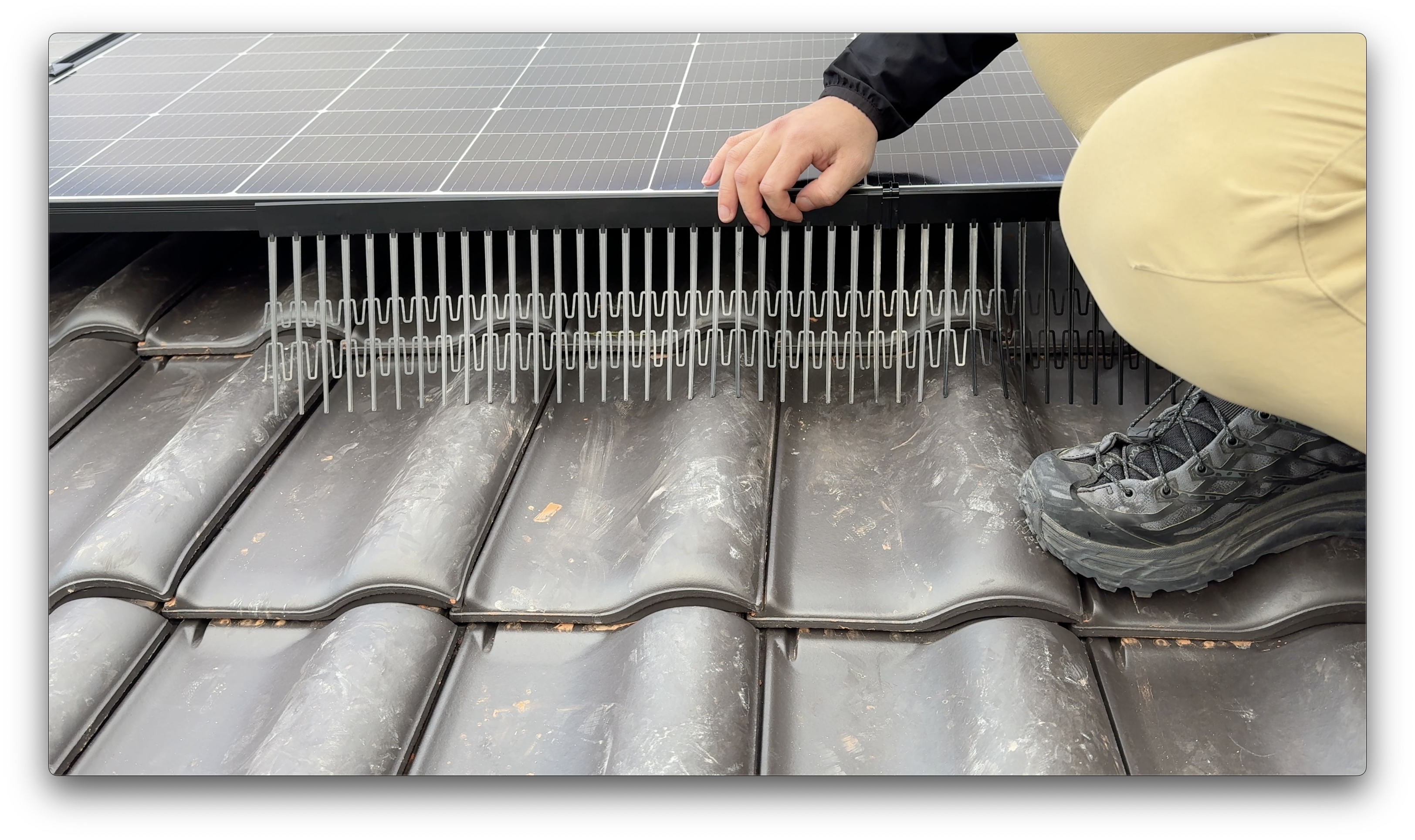
A clip-on mesh barrier system such as PV Protector® seals the under-panel cavity around the full perimeter of the array. Once installed, it prevents bird access entirely — eliminating nesting, debris accumulation, cable pecking, and the cascade of damage that follows.
The effect on inspection requirements is significant. Monthly monitoring becomes more reliable because the system is not subject to unpredictable wildlife-related performance variations. Semi-annual visual checks become simpler because there is no bird activity to assess. Annual professional inspections can focus on module condition, mounting integrity, and electrical connections rather than spending time on nest removal and cavity assessment. Comprehensive electrical testing is less likely to reveal cable degradation because the primary cause of accelerated cable damage has been eliminated.
Preventive protection does not eliminate the need for inspection. But it substantially reduces the scope, cost, and complexity of every inspection cycle — and it prevents the most common pathway from minor issue to major failure.
Building an Inspection Schedule
For installers and system owners establishing an inspection routine, the following framework provides a practical starting point.
Monthly monitoring reviews should be conducted twelve times per year, requiring no specialist skills and taking five to ten minutes each. Semi-annual visual checks should be conducted in spring and autumn, requiring basic observation skills and taking fifteen to thirty minutes each. The annual professional inspection should be scheduled in late spring or early summer — after the peak nesting season and before the highest-production summer months — and should take one to two hours for a typical residential system. Comprehensive electrical testing should be scheduled at system age five, then every three to five years thereafter, or whenever monitoring data suggests a developing fault.
Installers who offer maintenance contracts should consider including bird protection installation as part of the initial commissioning. This reduces the ongoing maintenance scope, lowers the cost of each inspection visit, and differentiates the installer’s service from competitors who offer installation only.
Conclusion
Solar panels are durable, but they are not self-maintaining. A structured inspection programme — scaled from monthly monitoring through to periodic electrical testing — ensures that developing faults are identified early, safety risks are managed, and the system delivers its full performance potential over its 25-year design life.
The single most effective measure an installer can take to reduce long-term inspection complexity is to prevent the most common source of damage at the point of commissioning. A clip-on mesh system such as PV Protector® seals the under-panel cavity permanently, eliminating bird nesting and the progressive cable, connector, and module damage that follows.
Inspection tells you what has gone wrong. Prevention ensures there is less to find.
Comments