
Solar Bird Protection Regulations EU: A Per-Market Reference for EPCs and Installers
Updated: May 29
Bird protection on photovoltaic arrays is no longer a discretionary detail. Across the European Union, a growing intersection of nature-conservation directives, electrical-safety standards, insurance requirements, and public-tender specifications is reshaping how project teams document, specify, and commission rooftop solar installations. Solar bird protection regulations EU project managers must navigate are not concentrated in a single statute — they are distributed across an EU baseline (the Birds Directive), national wildlife and building codes, IEC and EN standards, and increasingly explicit insurer exclusions. This reference consolidates the most relevant rules for pitched-roof commercial and agricultural solar installations in Germany, Italy, Spain, France, and Poland.
The EU Baseline: Birds Directive and Protected Species
The starting point for any project manager evaluating solar bird protection regulations EU-wide is Directive 2009/147/EC — the consolidated EU Birds Directive. The directive applies to all naturally occurring wild bird species in the European territory of the Member States. It prohibits the deliberate killing or capture of birds, the destruction of their nests and eggs, and the deliberate disturbance of birds during breeding and rearing periods.
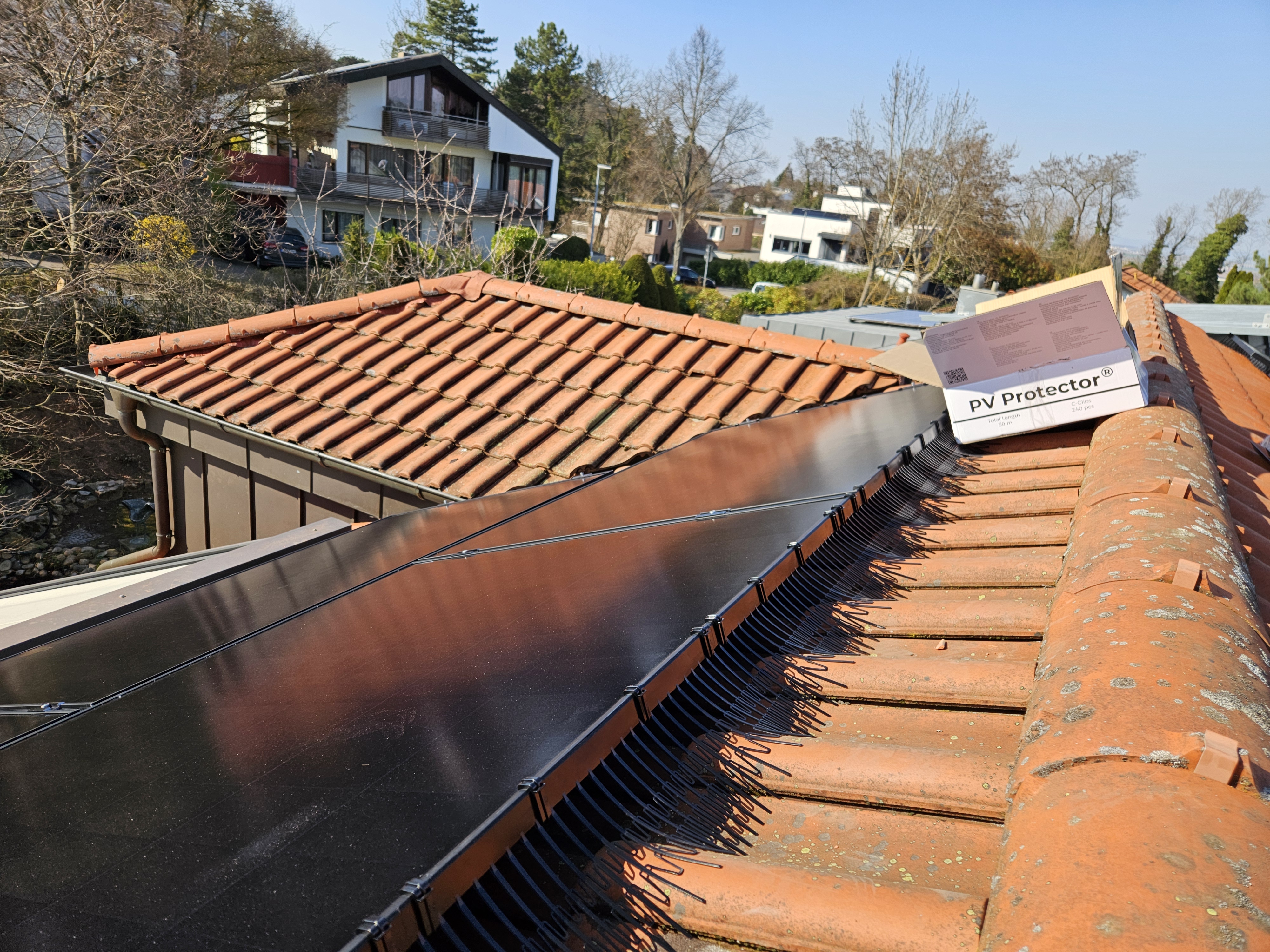
For solar PV, the practical implications are concrete:
- A project that interferes with an active nest of a protected species during breeding season may require derogation under Article 9 of the directive — even when the structure being installed (the array) is otherwise lawful. - Common synanthropic species (rock dove, house sparrow, common starling) are still wild birds within the meaning of the directive in most Member States, even if they are not listed as endangered. - Removing a nest before it is occupied is generally permitted; removing it during incubation or chick rearing is generally not, regardless of species.
The operational consequence: Perimeter Segments and C-Clip systems should be specified and installed before the first nesting season after array commissioning, not after a complaint arrives in mid-spring. Once nesting is established, the legal pathway to remediation narrows considerably and timelines stretch.
Building, Electrical, and Fire Safety Standards That Apply
National transposition of EU directives interacts with technical standards that govern the array itself. While these standards do not specify bird-protection components by name, they define the duty of care that determines whether a bird-related fault is treated as a design defect or as an act of nature.
Electrical safety and module integrity
- IEC 61730 (Photovoltaic Module Safety) — defines insulation and arc-fault thresholds. Damaged DC cables abraded by nesting material or claws can trigger non-conformance against this standard. - IEC 62446-3 — covers thermographic inspection and outdoor verification. Hot spots traceable to ventilation blockage from nests are recordable findings under this standard. - EN 50539 family — surge protection requirements that interact with arc-fault scenarios where bird-damaged conductors are present.
Building and roof-system standards
- EN 1991 (Eurocode 1, wind and snow loads) — Perimeter Segments and C-Clip systems must not invalidate the wind-load assumptions of the original mounting design. - DIN VDE 0100-712 (Germany) — installation of PV systems in buildings; the required protective measures are sensitive to anything that increases short-circuit risk. - CEI 64-8 / 82-25 (Italy) — Italian electrical standards for low-voltage installations and PV plants. - NF C 15-712 (France) — PV-specific installation standard that aligns with the Consuel inspection regime. - REBT ITC-BT-40 (Spain) — Reglamento Electrotécnico de Baja Tensión, specific to generation installations.
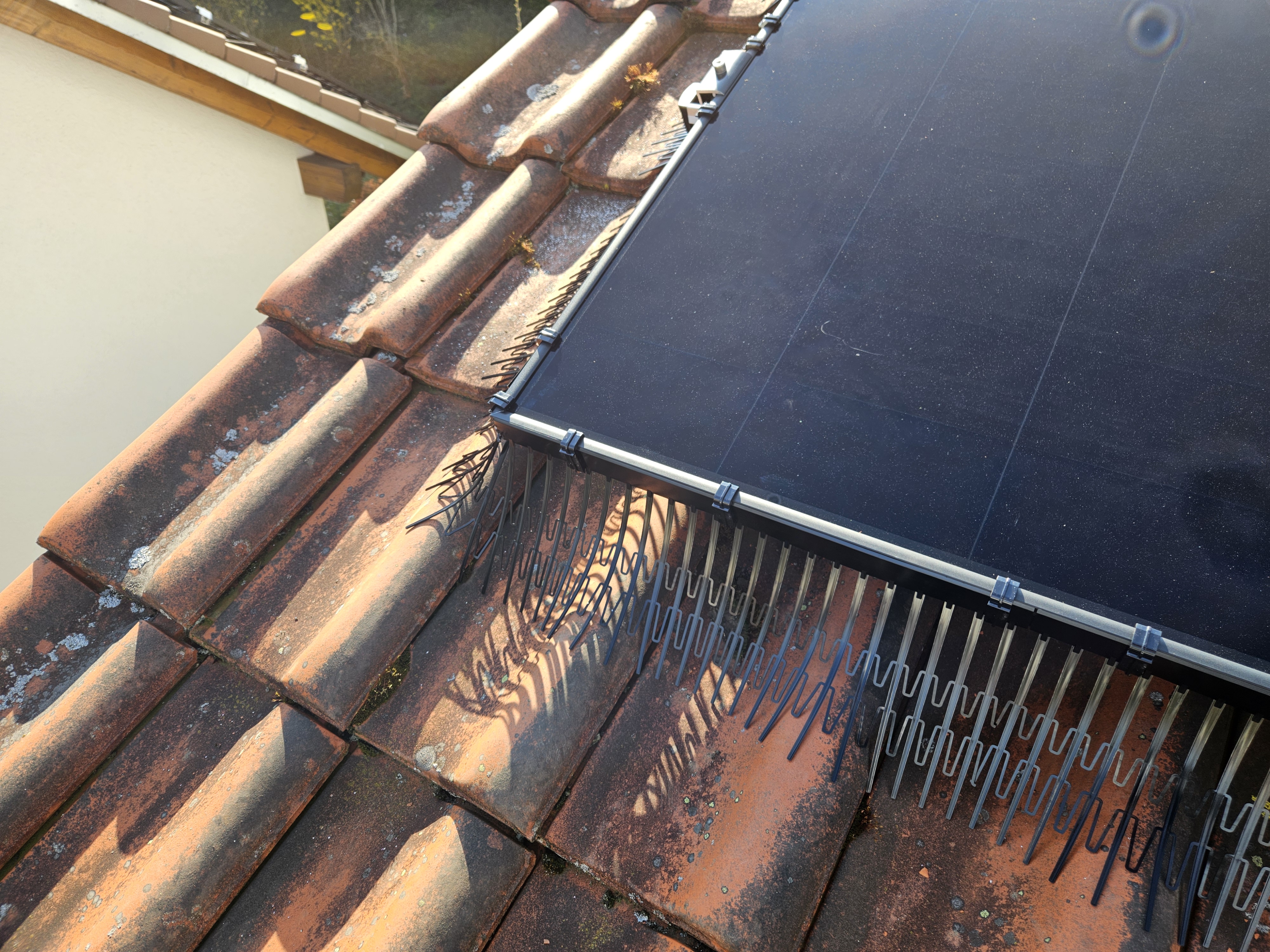
A project manager preparing tender documentation should be able to state, in writing, that the bird-protection components specified do not interfere with compliance against the standards listed above. A tool-free C-Clip system that grips the module frame without drilling, screwing, or adhesive bonding generally satisfies this — because the module frame and cable management are unmodified.
Country-by-Country Regulatory Landscape (DACH, IT, ES, FR, PL)
The following per-market summary is a working reference, not legal advice. Each Member State has additional regional ordinances (Bundesländer in Germany, Comunidades Autónomas in Spain, Régions in France, Voivodeships in Poland, Regioni in Italy). Always verify the current text of national wildlife and building law before specifying.
Germany (DACH baseline)
- Bundesnaturschutzgesetz (BNatSchG) § 44 — strict protection for all native bird species; nest disturbance is restricted from 1 March to 30 September in most Länder. - Tierschutzgesetz — overarching animal-welfare framework; non-lethal exclusion is required. - Roof-system intervention: DIN VDE 0100-712 plus regional Landesbauordnung. Many Länder require that any retrofit accessory must not invalidate the original Statik calculation of the mounting system. - Insurance practice (broker feedback in 2025-2026): some DACH installer-warranty contracts and PV operator policies have begun limiting cover for bird-related damage where no documented bird-protection system is in place at commissioning. The picture is not uniform — wording varies by insurer — but the trend is mentioned consistently enough by Handwerker-feedback that documenting the system at handover is increasingly worthwhile as a precaution.
Italy
- Legge 157/1992 — Italian implementation of the Birds Directive; protected-species lists are managed through ISPRA. - CEI 0-21 / 0-16 / 64-8 / 82-25 — electrical and grid-connection standards; commissioning inspections (collaudo) check for visible damage including bird-related defects. - Public tenders for agricultural and SME pitched-roof projects increasingly require an explicit "sistema antivolatile" line in the BOS specification. - ENEA documentation cycle for tender files commonly includes a fire-safety statement; nesting under modules is one of the named risk paths.
Spain
- Ley 42/2007 — Patrimonio Natural y de la Biodiversidad; protected-species lists at national and autonomous-community level. - REBT plus RD 244/2019 for autoconsumo (self-consumption) installations; commissioning inspectors are alert to anything that affects the integrity of the mounting system. - The autoconsumo growth pattern in Andalucía, Cataluña, and Murcia has produced a high density of small-commercial pitched-roof installations where bird-protection retrofits are now becoming standard at first annual O&M.
France
- Code de l'environnement, articles L411-1 et suivants — protection des espèces; the strict-protection regime is similar in scope to Germany's. - NF C 15-712 plus Consuel attestation — Consuel inspections are visual and do not always check bird protection explicitly, but a damaged DC cable from bird abrasion will fail the next AGCP-type inspection. - Insurance market (anecdotal): brokers serving Mediterranean départements report that bird-related damage is increasingly raised alongside connector failures and cable abrasion when discussing avoidable PV claims, although published industry statistics on the relative frequency are still scarce.
Poland
- Ustawa o ochronie przyrody — strict protection for native bird species, with regional derogation procedures. - PN-HD 60364 (the Polish adoption of HD 60364) — electrical safety baseline. - Mój Prąd and Czyste Powietrze documentation does not currently mandate bird protection, but commercial installers serving pitched-roof agricultural buildings increasingly include it in BOS as an insurance-aligned line item.
Insurance, Warranty, and Tender Documentation Requirements
Across all five markets, the strongest near-term driver of solar bird protection regulations EU-wide is not nature-conservation law — it is the convergence of insurance practice and tender documentation requirements.
Three specific documentation patterns have emerged:
- Pre-commissioning photo evidence — the commissioning file is expected to include images of the installed bird-protection system. The image set proves the system was present at handover. - Retrofit derogation memo — when a system was originally installed without perimeter protection and is later retrofitted, insurers increasingly request a written memo explaining why the system was added and confirming no module frames were drilled or modified. - Annual inspection log — the bird-protection line item is checked annually alongside string inverter health and DC cable integrity. A missing line item triggers questions, even when the array is performing correctly.
For asset owners thinking about ROI rather than compliance, the documentation requirement creates an indirect benefit: a portfolio with consistent bird-protection records sells at a higher price in secondary-market PPAs because diligence buyers can close due-diligence faster.
Specifying Compliant Bird Protection: A Practical Checklist
When preparing the BOS specification for a pitched-roof commercial or agricultural project, the following checklist consolidates what most EU markets expect:
1. Species-neutral Perimeter Segment design — the system should exclude birds without harming them; spike systems and chemical deterrents are increasingly questioned by environmental authorities and by clients with ESG reporting obligations. 2. No drilling, no adhesives — module-frame integrity is the foundation of warranty preservation. A C-Clip and Perimeter Segment system that grips the lower edge of the module frame without modification is the path of least regulatory friction. 3. UV-stabilised polymer materials with verifiable specification — UV-stabilised PC+ABS for the C-Clip, UV-stabilised HDPE (UV stabilisers 944 and 622) for the Perimeter Segments, and UV-stabilised PA66 for the Cable Ties. Together these provide the durability required across the full ten-year system warranty period. 4. Continuous perimeter coverage — partial coverage that leaves gaps at brackets or cable entries is treated as no coverage by insurers when a claim arises. 5. Photographic commissioning record — minimum one wide shot per row plus one detail shot per ten metres of perimeter. 6. Annual inspection alignment — the maintenance log must reference the bird-protection system explicitly and record visual condition.
A specification that meets these six points generally satisfies the documentation expectations across the DACH, IT, ES, FR, and PL markets surveyed above. Local authorities and insurers may add their own requirements, but they rarely conflict with this baseline.
How Solar Bird Protection Regulations EU-Wide Translate to Project Risk
Solar bird protection regulations EU project teams meet most often translate into three operational risks: a nest-disturbance derogation that delays a remediation visit, an insurance exclusion that turns a small cable repair into an out-of-pocket loss, and a tender requirement that disqualifies a bid because the BOS line item was missing.
Project teams who solve all three at the design stage absorb the protection cost into the BOS budget and remove the issue from the project's risk register. The protection itself becomes invisible — which is the correct outcome. Bird damage on a properly specified pitched-roof array should be a non-event for the lifetime of the system.
For EPCs preparing project ROI calculations, this is the case where regulatory compliance and economic optimisation align: the cheapest legally compliant array over its full operational life is the one that is bird-protected from day one.
Practical Next Steps for Project Managers
For project teams sizing and specifying pitched-roof commercial PV in the EU in 2026, the following sequence keeps regulatory exposure low and tender documentation clean:
- At design stage — include bird-protection as a named BOS line item with material specification and quantity. - At procurement — request supplier conformity documentation that confirms compatibility with the module frames specified (30 / 35 / 40 mm typical) and absence of drilling, screwing, or adhesive bonding. - At commissioning — photograph the installed system per row and archive in the project handover file. - At first annual inspection — confirm system condition, document any maintenance, and update the asset register. - At secondary-market sale — include the bird-protection record in the diligence pack.
For project managers building out the maintenance side of the documentation file, the PV system maintenance guide consolidates the inspection cadence and condition-recording practices that align with insurer expectations across these markets.
Key Takeaways
Solar bird protection regulations EU project teams encounter are concentrated in five places: the Birds Directive baseline, national wildlife and building codes, IEC and EN technical standards, insurance market practice, and tender documentation expectations. None of these alone forces a specific product choice, but together they make the case for a documented, non-invasive, species-neutral bird-protection system installed at commissioning on every pitched-roof commercial and agricultural array.
The simplest path to compliance is also the simplest path to BOS efficiency: specify the system once, install it tool-free at commissioning, photograph the installation, and reference it in the annual inspection log. The result is regulatory clean-slate, insurance-friendly documentation, and a project asset that retains value through its full operational life.
Comments