
Bird Damage to Solar Panels: The Early-Warning Guide Every Homeowner Should Have
Bird damage to solar panels is a slow story, not a sudden one. Nobody wakes up to a roof full of nests. It starts with two pigeons trying out the gap under the lowest row of modules in early spring, and if nothing stops them, it ends a few seasons later with packed nesting material, chewed cable insulation and an array that quietly produces less than it should. Every stage of that story leaves visible traces — and most of them can be read from the garden, with a phone camera and five minutes of attention.
The problem for installers is that the customer is the only person who sees the roof every day, and almost nobody has told them what to look for. The result is the callback everyone knows: a nest discovered in year three, in the middle of the breeding season, on a system that was quoted without bird protection. This article is written so you can hand it to customers as it stands — the six signs below are deliberately phrased for an owner standing in the garden — with a closing section on how to turn that awareness into a planned visit rather than an emergency.
The guide assumes a pitched-roof system, where the modules sit on rails above the tiles and leave an open gap along the lower edge. That gap is what birds are after, and PV Protector® exists for exactly that configuration and no other. Unlike pitched roofs, flat-roof, ground-mounted and open-field systems behave differently and are outside the scope here.
Why Bird Damage to Solar Panels Starts Small
The space under a rooftop array is, from a pigeon's point of view, close to ideal: sheltered from rain, warmed from above, out of reach of cats and mostly out of sight of people. A pair that finds it will return to the same spot day after day, and once one pair has settled, others tend to follow.
What makes bird damage to solar panels easy to miss is that the birds are not doing anything dramatic. They bring in twigs, grass and feathers a little at a time. Their droppings accumulate on the lower row of modules and on the tiles below. They walk on the cables. None of this looks alarming on any single day. It only becomes a problem because it compounds over months, in a space nobody looks into after commissioning.
That is why the useful skill for a homeowner is not diagnosing the damage — that is the installer's job — but noticing the early signs while the problem is still small. And that is why it pays an installer to teach it: an owner who reports a line of droppings in March is a planned visit; an owner who reports a fallen chick in June is a callback with legal timing constraints attached.
Six Early Signs You Can Check From the Ground
None of the checks below involve a ladder. All of them can be done from the garden, the street or a window on the opposite side of the house.
1. Droppings in a line along the lower module edge
Random droppings anywhere on a roof are normal. A concentrated line of them on the glass of the lowest row of modules, or on the tiles and gutter directly below, is not. It tells you birds are perching on the bottom frame edge repeatedly — which usually means they are going in and out underneath. Our article on bird droppings on solar panels explains why this particular pattern also matters for output.
2. Nesting material poking out of the gap
Take a photo of the lower edge of the array at full zoom, then look at it on a larger screen. Twigs, dried grass, straw or feathers protruding from between the modules and the tiles are a direct sign that a nest is being built or has already been built. In autumn and winter, material that has blown out and collected in the gutter below the array points to the same thing.
3. Repeated traffic at the same point of the roof
Watch the roofline for a few minutes around sunrise or shortly before dusk. Birds that are merely passing over land in different places and move on. Birds that are living under the array arrive and leave through the same gap, at the same point of the lower edge, again and again. A pigeon disappearing under a module and not reappearing is as clear a sign as you will get without climbing.
4. Noise from the roof space
Cooing, scratching or flapping heard from inside the house — typically in the morning, and typically from the upstairs rooms directly under the array — is often the first thing owners notice. The modules and the roof structure carry sound well. If it happens repeatedly, treat it as a sign rather than a nuisance.
5. Feathers, eggshell fragments or dead chicks below the eaves
A nest that has been in use for a season sheds evidence. Feathers on the lawn under the array edge, fragments of eggshell, or in the worst case a fallen chick, all mean the cavity has been occupied long enough to raise young. This is also the point at which the legal protection of active nests becomes relevant, as discussed below.
6. One string of your monitoring data lagging the others
If your inverter app shows production per string, compare them on a bright, clear day. A single string consistently a little below its neighbours, when the whole roof gets the same sun, points to something local: shading, soiling on one row, or in some cases a nest reducing airflow behind a group of modules. Monitoring data alone does not prove birds are the cause, but combined with any of the five visual signs above, it is a strong hint. Our guide to solar panel overheating and the air gap under modules covers what a blocked cavity does to temperature.
What Those Signs Mean Underneath the Modules
A homeowner does not need to see under the array to understand what is likely going on there once the signs above are present.
Cables. The DC cables and connectors run through exactly the space where birds nest. Pigeons walking on them, pecking at them and covering them in droppings does the insulation no good over time. Installer feedback (anecdotal, not a measured statistic) is that neglected arrays often show chewed or abraded cable jackets, and while rodents are usually the more aggressive chewers, birds create the conditions that attract them.
Ventilation. Modules are mounted with a gap above the tiles partly so that air can move behind them and carry heat away. Nesting material packed into that gap does the opposite. The result is warmer modules on hot days and, over the years, a system that runs harder than it was designed to.
Moisture and corrosion. Droppings hold moisture and are corrosive to metal over time. Concentrated on module frames, cable clips and mounting hardware, they accelerate wear on components that were meant to last as long as the modules themselves.
Fire pathway. Dry nesting material next to electrical connectors is a combination no electrician likes. The probability on any one roof is low, but the consequences are severe enough that installers treat nests as a reason to inspect rather than something to leave until the next service.
The point is not that all of this has happened on your roof. It is that once birds are established, all of it is in progress — and it is far easier to close the perimeter before that than to remediate afterwards. Our article on birds nesting under solar panels explains how pigeons, sparrows and starlings differ in what they do to an array.
What Not to Do
A few well-meant reactions make things worse.
Do not go on the roof yourself. This is worth saying plainly. A fall from a roof is a life-changing injury, and a pitched roof with modules on it is harder to move on than it looks. Everything in this guide can be done from the ground; everything beyond it belongs to a professional with fall protection.
Do not disturb an active nest. Wild birds, their eggs and their nests in use are protected across the EU under the Birds Directive, and national law adds detail and penalties on top. Removing an occupied nest is not just unkind; in many jurisdictions it is an offence. The practical consequence is that the timing of any intervention depends on the local breeding calendar. Our year-round guide to seasonal bird activity and solar maintenance sets out when the window is usually open.
Do not pressure-wash droppings off the modules. High-pressure water can force moisture into frame edges and connectors and can void module warranties. Cleaning belongs to the installer or a specialist cleaner who knows what the module manufacturer permits.
Do not improvise a barrier. Spikes glued to frames, wire pushed into the gap, foam or adhesives all tend to fail within a season, and some of them damage the frame or the module warranty on the way. A barrier that works has to close the whole perimeter, stay attached through a decade of sun and frost, and not interfere with the airflow the array needs.
When to Call Your Installer
Call as soon as you have two or more of the six signs above, or one of them repeatedly over a couple of weeks. That call is worth making even outside the breeding season, because the installer can plan the visit for the right point in the calendar and quote the work before it becomes urgent.
Be specific on the phone. Send the zoomed photo of the lower edge, note which side of the roof and roughly which modules, and mention whether you have heard anything from inside. An installer who arrives knowing where to look can often complete the inspection and the perimeter closure in a single visit.
Ask for two things: that the cables and connectors under the affected modules are inspected and photographed, and that the perimeter is closed with a system that fits the module frame without drilling. The first protects you from a fault that may already be developing; the second stops the cycle from restarting next spring.
For Installers: Turning the Guide Into Fewer Callbacks
The section above is written for the owner. This one is for you.
Hand it over at commissioning. The moment the customer is most receptive to "here is what to watch for" is the day the system goes live. A printed one-pager with the six signs, or a link to this article in the handover email, costs nothing and sets the expectation that bird activity is something to report early, not something to be embarrassed about in year three.
Make it a line in the annual service reminder. If you send maintenance reminders, add one sentence: "Have you noticed droppings, nesting material or birds going under the lower edge of the array? Reply with a photo." A photo from the ground tells you whether the visit needs a bird-protection quote attached before you climb the ladder.
Quote the perimeter at the first sign, not the first nest. An owner who reports sign one or two in late winter can have the perimeter closed before the breeding season starts, with no nest to work around and no legal timing question. An owner who reports sign five in June cannot. The difference in how that job goes — and in how the customer talks about you afterwards — is entirely a matter of when the conversation happened.
Photograph the underside every time. Whatever you find, document the cables and connectors under the affected modules before and after. It protects the customer, it protects you if a fault develops later, and it makes the case for bird protection on the next quote without any persuasion needed.
Closing the Perimeter Properly
The reason this article keeps coming back to the perimeter is that the gap along the lower and side edges of the array is the whole problem. Close it, and the birds have nowhere to go; leave it, and every other measure is temporary.
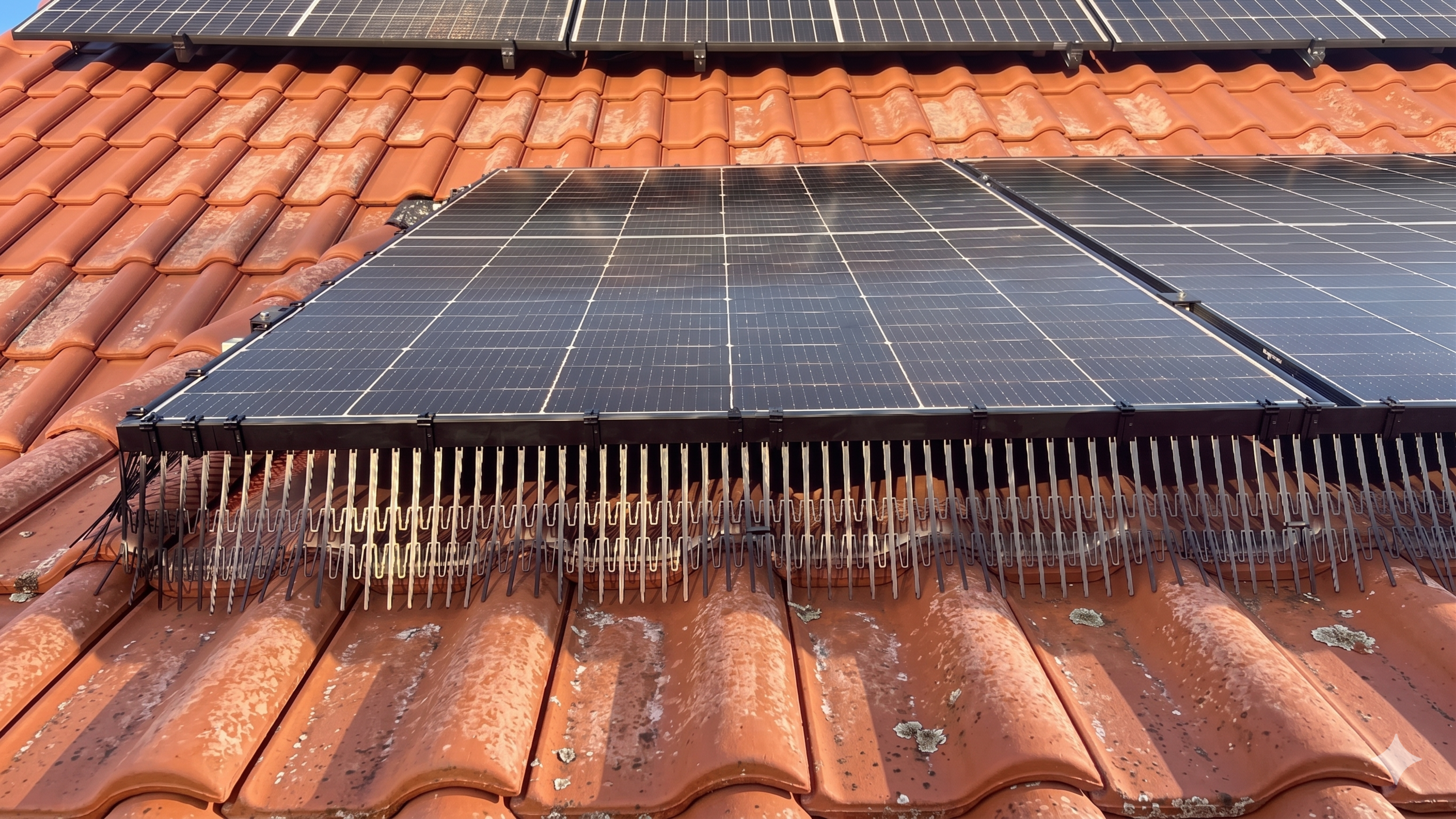
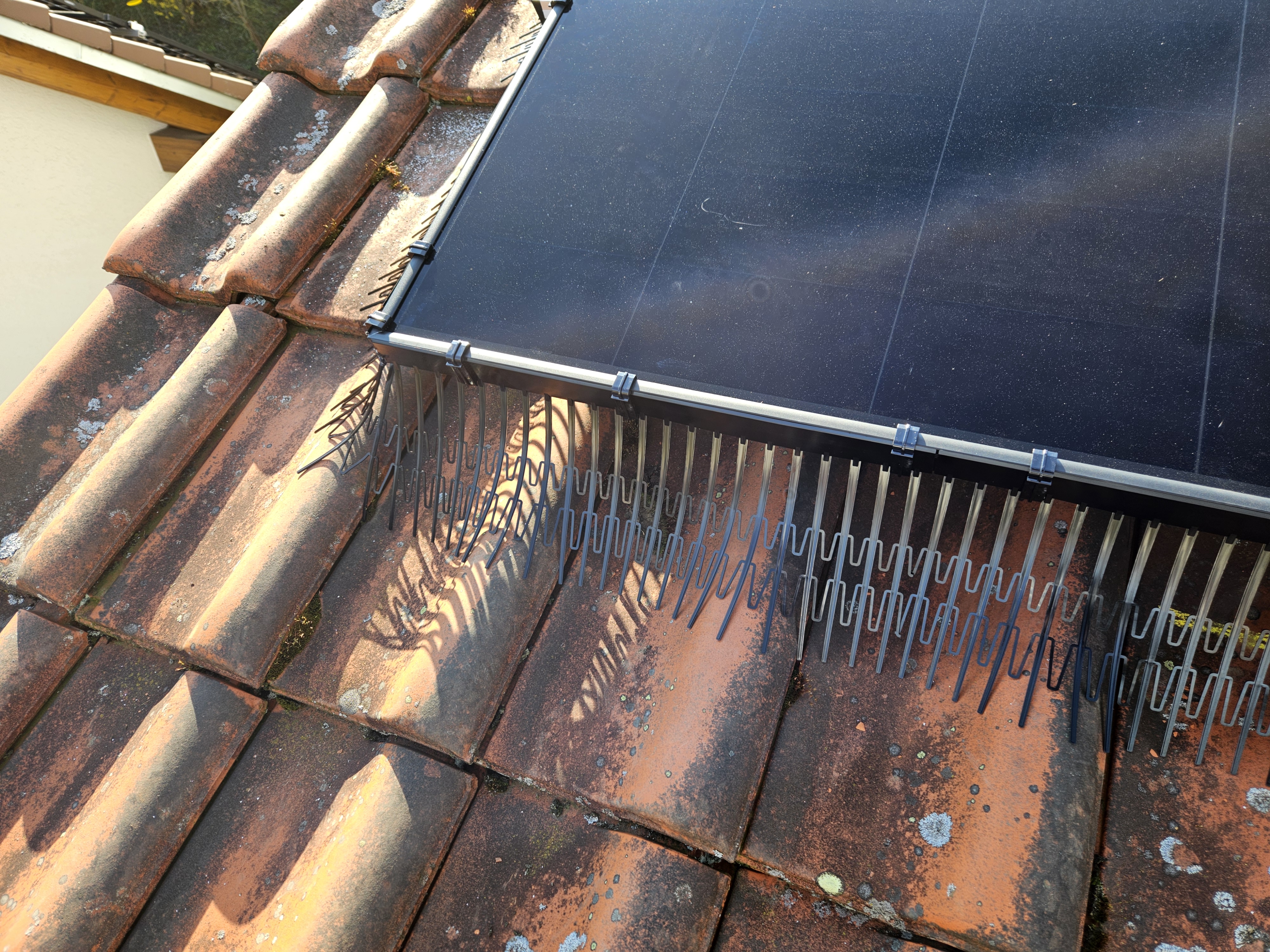
PV Protector® closes that gap with three engineered components. The Perimeter Segments, made of HDPE with UV stabilisers 944 and 622, form the barrier itself and come in two heights, 150 mm (Standard) and 200 mm (Extended), to suit different rail and roof geometries. C-Clips moulded from UV-stabilised PC+ABS snap the Segments onto module frames of 30, 35 and 40 mm — tool-free, with nothing drilled or glued to the frame, so the module warranty stays intact. UV-stabilised PA66 Cable Ties secure the run. The system carries a 10-year warranty per the manufacturer specification and is designed exclusively for pitched roofs with a defined lower module edge.
Because the Segments close the perimeter without sealing it, the array keeps the ventilation path it was built with. That is the difference between keeping birds out and boxing the modules in.
The Five-Minute Habit
Bird damage to solar panels is one of the few maintenance problems that gives an owner plenty of warning. Twice a year — once in late winter before the breeding season, once in autumn after it — walk to the far side of the garden, zoom in on the lower edge of the array, and look for droppings, nesting material and traffic. Add a glance at the string data on a clear day. If the roof is clean, five minutes are lost. If it is not, the problem has been caught at the point where a single installer visit fixes it.
For installers, the habit is even simpler: make sure every customer has read this once. The owners who know what to look for are the ones who call in February with a photo, not in June with a nest.
To specify PV Protector® for pitched-roof systems, or to discuss installer and distributor conditions, contact the PV Protector® team.
Comments