
Pigeon Proofing Solar Panels: What Local Rules Actually Require
Pigeon proofing solar panels looks like a purely technical job until the moment somebody points at the eaves and says the word "nest". At that point the work stops being about clips and gaps and starts being about law — and the law is not the same in Stuttgart, Milan, Valencia and Kraków. This article maps the legal layer that sits over the physical one, so that a pitched-roof job is planned in the right order instead of being paused halfway through.
Everything below assumes a pitched roof with a defined lower module edge. PV Protector® is engineered for pitched roofs and does not fit flat-roof ballasted systems, ground-mount arrays or open-field PV.
The One Rule That Applies Almost Everywhere
Across the EU, the common denominator is the nest. Directive 2009/147/EC, the Birds Directive, establishes a general system of protection for naturally occurring wild bird species and includes prohibitions on deliberately destroying or damaging nests and eggs. Every EU market transposes that framework into national law, which is why the practical answer is so consistent: an empty roof is a free decision, an occupied nest is a legal question.
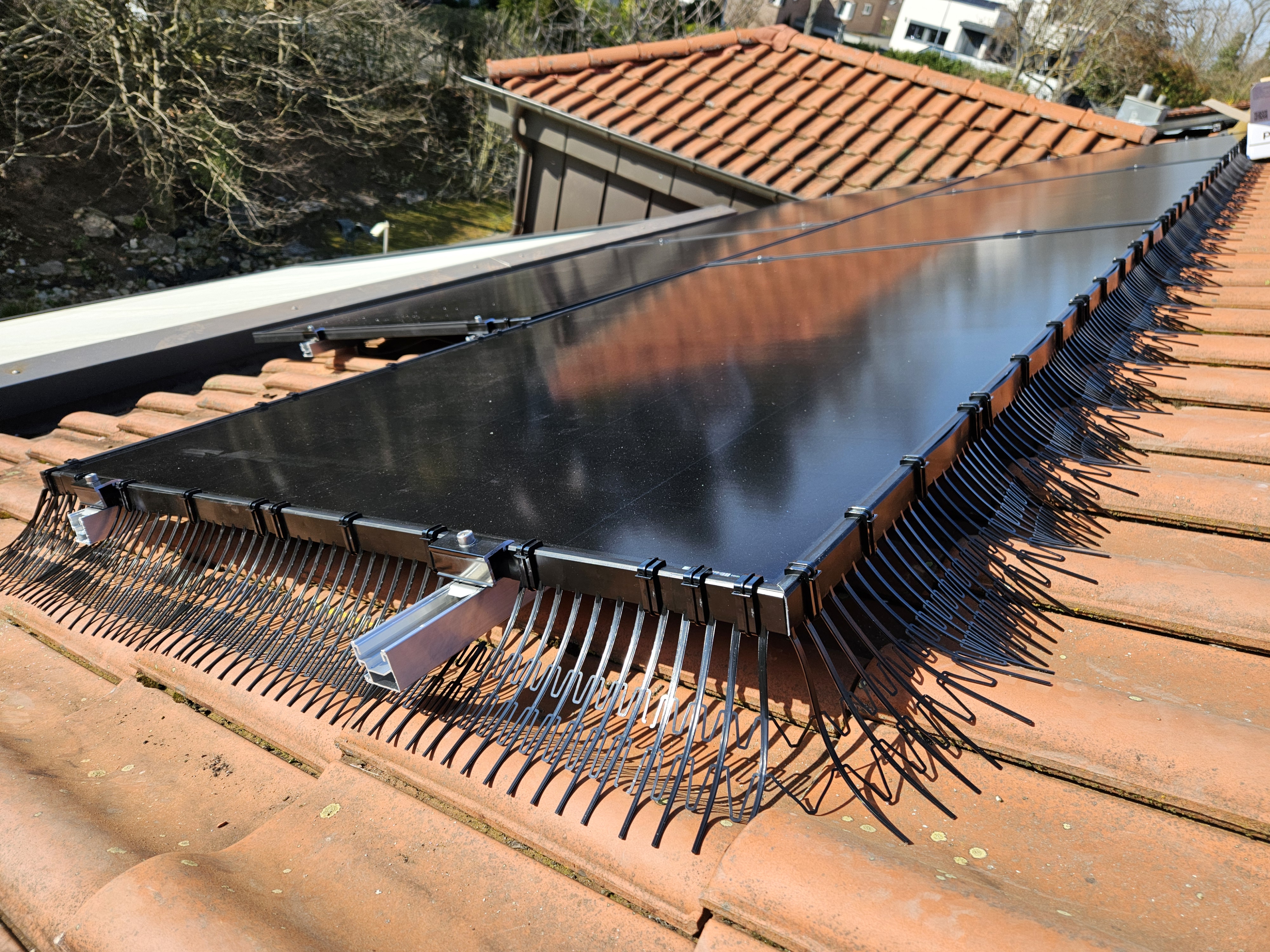
That single distinction drives the whole planning logic. Physical exclusion fitted before birds settle is routine construction work. The same exclusion fitted over an active nest can be an offence, and the authority that decides is rarely the one the customer expects.
You will find the pan-EU framing in more detail in our overview of bird protection regulations across EU solar markets. What follows here is the layer underneath it — the national and local rules that decide what happens on a specific roof.
Why the Same Bird Has a Different Legal Status in Each Market
The feral city pigeon is the clearest example of how far national classifications diverge.
Germany. The Berlin animal-welfare authority describes city pigeons as feral domestic animals rather than wild birds, which means they are not treated as a specially protected species under federal nature-conservation law. That does not make a roof a free-for-all. § 44 BNatSchG prohibits damaging or destroying the breeding and resting sites of specially protected species and disturbing them during breeding, rearing, moulting, wintering and migration periods — and sparrows, swifts and house martins, which use the same warm cavity under a PV array, sit squarely inside that protection. From a ladder you cannot always tell which species built what you are looking at. Animal-welfare law applies to the pigeons regardless.
Poland. The opposite classification. Under the 2016 species-protection regulation (Dz.U. 2016 poz. 2183) the city pigeon, Columba livia f. urbana, is listed under partial species protection, and art. 52 of the Nature Conservation Act prohibits destroying, removing or damaging nests of protected species. Polish guidance commonly cites a breeding window of roughly 1 March to 15 October during which nests must be left alone. Where a genuine safety or sanitary reason requires intervention, the decision route runs through the Regional Directorate for Environmental Protection (RDOŚ), not through the property owner.
Italy. Case law has treated the city pigeon as wild fauna rather than a domestic animal, which places it inside the framework of Law 157/1992. Article 19 of that law assigns population-control powers to the Regions, and several Regions have published their own control plans for Columba livia forma domestica. The operative answer in Italy therefore comes from the Region, not from Rome.
Spain. Law 7/2023 on animal rights and welfare requires local authorities to prioritise non-lethal population control of urban fauna in their animal-protection plans. For an installer, that is a helpful tailwind: permanent physical exclusion is exactly the kind of non-lethal measure the law steers towards.
Austria and Switzerland. Both decentralise. Austrian nature-conservation law is made at Land level rather than federally; BirdLife Österreich's guidance for building owners states that deliberately removing birds' nests during the breeding season is generally not permitted and that renovation work should be scheduled after the breeding season instead. Switzerland regulates wild birds through the federal hunting and wildlife-protection act (JSG, SR 922.0), which the cantons implement — so the binding answer for a specific site comes from the cantonal authority.
Add municipal bylaws on top of all of this. Feeding bans, façade and heritage protection rules, and local sanitary ordinances vary town by town and are the layer most often missed, because nobody thinks to look for them until a neighbour complains.
Pigeon Proofing Solar Panels Before the Nest, Not After
Once you accept that the nest is the trigger, the planning rule writes itself: schedule exclusion outside the local breeding season, and survey the array before you quote.
A short pre-installation survey settles the questions that matter. Is there existing nesting material under the modules? Are there active nests, and can you tell what built them? What is the local breeding window, and does the customer's preferred install date fall inside it? Our pre-installation site survey checklist covers the physical side of that visit; on a roof with visible bird activity, add two legal questions to it — which authority is competent here, and does anything need clearing before work starts.
Where an active nest is found, the honest advice to the customer is usually to wait. Rescheduling a half-day job by a few weeks is cheap. Removing an occupied nest and discovering afterwards that it belonged to a protected species is not, and it is the installer standing on the roof who carries that exposure.
What This Changes on the Quotation
Three practical habits keep legal risk off the installer's side of the contract.
- Put the timing in writing. State the intended install window and note that work may shift if active nesting is found during the survey. It converts a potential dispute into a documented, agreed condition. - Photograph the underside before you start. Images of the eaves gap taken at survey and again at handover document the condition you found and the condition you left. They are also what an insurer asks for later. - Name the competent authority in the customer's file. For a German site that may be the lower nature-conservation authority; for a Polish one, the RDOŚ; for an Italian one, the Region. Knowing who to call before you need to call them is most of the work.
How the Barrier Itself Should Be Built
Once timing is settled, the exclusion has to hold for the life of the array — a temporary fix invites the same conversation again next spring.
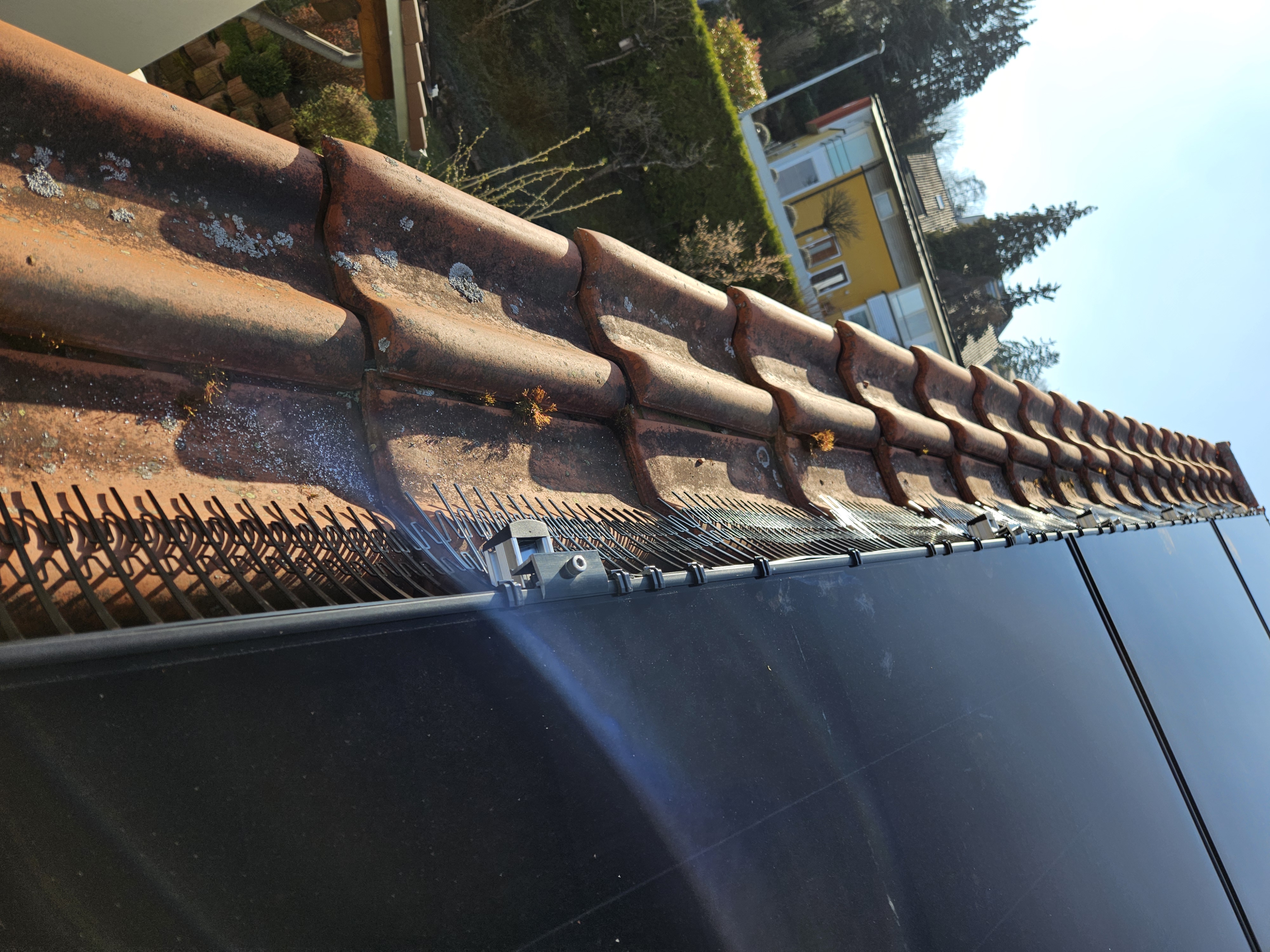
PV Protector® closes the gap with three engineered components. The Perimeter Segments are made of HDPE with UV stabilisers 944 and 622 and seal the open edge under the modules; they are available in two heights, 150 mm (Standard) and 200 mm (Extended). The C-Clips, moulded from UV-stabilised PC+ABS, snap the Segments onto module frames of 30, 35 and 40 mm — tool-free, with no drilling into the frame and therefore no module-warranty questions. UV-stabilised PA66 Cable Ties secure the run. The system carries a 10-year warranty per the manufacturer specification and is designed exclusively for pitched roofs with a defined lower module edge.
Because nothing is drilled and nothing is glued, the installation itself raises no structural or fabric-alteration questions on a normal pitched roof — which keeps the conversation with the customer, and with any authority, focused on timing rather than on method. The component-level detail is set out in our bird-proofing kit overview.
Before You Touch the Array
Five checks, in order, cover almost every pitched-roof job in these markets.
- Look under the modules first. Nesting material, droppings and feathers at the eaves edge tell you what season you are actually in. - Establish the local breeding window. It is regional, not European, and it moves with latitude. - Assume protection until proven otherwise. If you cannot identify the species, plan as though it is protected. - Ask the competent authority, not the internet. A single phone call to the local nature-conservation or environmental body resolves what a forum thread cannot. - Fit permanent exclusion outside the breeding season. It is the only step that ends the cycle rather than deferring it.
The Legal Question Is Really a Scheduling Question
Pigeon proofing solar panels rarely fails on the hardware. It fails on the calendar — work booked into the middle of a breeding season, on a roof nobody surveyed, in a jurisdiction nobody checked. Survey early, confirm the local rules once per market rather than once per job, and fit a permanent perimeter barrier when the roof is empty. Everything after that is a half-day on a ladder.
To specify bird protection for your next pitched-roof project — or to discuss installer and distributor conditions — talk to the PV Protector® team.
Comments