
Rodents Under Solar Panels: Telling Chew Marks From Bird Damage
A service call for "damaged wiring on the roof" is not one fault. It is at least three different faults wearing the same jacket. The cable is scarred, the string is down or intermittent, and the customer wants to know what happened — but the repair, the quote and the prevention measure all depend on which animal did it, and whether anything you fit afterwards will actually stop it happening again.
This article is a field guide to reading that evidence on a pitched-roof array: what rodents leave behind, what birds leave behind, what is simply mechanical wear, and — the part most articles skip — where the honest boundary of a bird-protection system lies. PV Protector® is engineered for pitched roofs with a defined lower module edge; it does not fit flat-roof ballasted systems, ground-mount or open-field PV.
Three Damage Mechanisms, One Symptom
From the inverter's point of view, all three look similar: rising insulation-resistance faults, an intermittent string, a residual-current trip. On the roof they are entirely distinct.
Gnawing is deliberate material removal. Rodents work with paired incisors, so the damage is bitten, not rubbed — a clean transverse cut, or a series of them, at the point where the animal could brace itself.
Abrasion is repeated relative movement between the cable and something harder: a frame edge, a rail lip, a tile. It removes jacket material slowly, over months or years, and it always happens at a contact point.
Contamination-driven degradation is the slowest of the three: nesting material packed against a cable, droppings, damp debris, and the heat cycling that follows once ventilation is blocked. The cable is not attacked; it is buried and cooked.
Birds are involved in the second and third mechanisms. Rodents own the first outright. That distinction is the whole diagnosis.
How to Identify Rodents Under Solar Panels on a Site Visit
Rodent damage has a signature you can photograph and put in a report.
- Cut geometry. Gnaw marks are short, paired, and transverse to the cable axis. You often see the jacket removed in a band, with the copper or the inner insulation exposed cleanly rather than worn smooth. Multiple parallel grooves in the polymer are characteristic. - Position. Damage sits where an animal can get purchase: cable loops hanging below the module, runs resting on a batten or tile, entry points at the roof penetration. Free-hanging service loops are the classic casualty. - Droppings and material. Rodent droppings are small, dark and elongated, and they concentrate along runs and in sheltered corners — quite unlike the flat white-and-dark splashes birds leave. You may also find shredded insulation, gnawed timber on the battens, or fibrous nesting material carried in from elsewhere. - Season and access. Reports cluster in autumn and winter as animals move under cover. Look for the route in — a gap at the eaves, an overhanging branch, a neighbouring flat roof.
None of this is exotic; it is the same forensics used on any roof void. What matters is that you record it before you cut the damaged section out, because the photograph is what justifies the remediation you are about to quote.
What Bird Damage Actually Looks Like
Birds rarely bite through a cable. What they do is occupy the space under the modules and change the conditions the cable lives in.
Nest building drags at cables. Pigeons and jackdaws move twigs, straw and wire-like material into the cavity and work it into position. Loose service loops get pulled, repositioned and pressed against frame edges. The cable ends up somewhere the installer never intended — and that new contact point is where abrasion starts.
Nesting material packs against the run. Dry organic material and feathers accumulate around cable ties and clips, holding moisture against the jacket and blocking the airflow that would otherwise carry heat away.
Droppings load the surface. Concentrated deposits along perch lines are acidic and hygroscopic; combined with UV exposure at the eaves, they age the outer jacket faster than the datasheet assumes.
The damage is diffuse, not local. This is the practical tell. Rodent damage is a point event you can circle with a marker. Bird-driven damage is a zone: a metre of chafed jacket, a dulled and hardened sheath, debris packed around the fixings, and often several cables affected in the same bay. The mechanics of that habitat are covered in more depth in our guide to birds nesting under solar panels.
Why Any of This Reaches the Fire Conversation
Damaged insulation is not only a yield problem. Fraunhofer ISE, together with TÜV Rheinland, investigated fire risk in photovoltaic plants and the mechanisms behind it, including arc formation and hot spots, and published a guideline for assessing and minimising that risk. Among its findings, DC connectors and cable connections are sensitive to installation faults and can arc when poorly executed (Fraunhofer ISE — PV Fire Protection).
Two things follow, and both are worth stating carefully. First, serious PV fires are rare relative to the installed base — this is not a scare story, and it should not be sold as one. Second, the conditions that damaged cabling creates on a roof are exactly the conditions that research points at: compromised DC insulation, plus, where birds are involved, dry nesting material sitting in the same cavity. The full picture of ignition paths and mitigation is set out in our solar panel fire risk and safety guide.
For the installer the takeaway is procedural rather than dramatic: cable damage on a roof is a defect to be closed out properly, documented, and prevented — not patched with tape and forgotten until the next call-out.
The Remediation Split: Two Problems, Two Answers
Here is where an honest article has to diverge from a sales pitch.
Rodent damage needs a rodent measure. Animals that gnaw through polymer are not stopped by polymer. Rodent-proofing a roof means metal-based barriers, closing the access route at the eaves and roof edge, removing the approach path — branches, adjacent structures — and, where infestation is established, a pest-control specialist. PV Protector® is a bird-protection system. It is not a rodent barrier, it is not sold as one, and it should never be specified as one. If you find gnaw marks, quote the rodent measure. Telling a customer otherwise costs you the second call-out and the relationship.
Bird-driven damage needs the habitat closed. This one is genuinely preventable at the perimeter, because the mechanism is occupation. If birds cannot get under the modules, they do not build nests there, they do not drag material across the cable runs, they do not pack debris around the fixings, and the perch traffic above drops with them.
Both cases share one prerequisite: cable management that was right in the first place. Runs clipped short, no free-hanging loops, correct bend radii, UV-rated fixings, nothing resting on a frame edge. A roof cabled to that standard survives incidental contact; a roof with a metre of slack hanging in the cavity offers every animal on it something to work with. The detail is in our solar cable management best practices for PV installers.
Closing the Habitat on a Pitched Roof
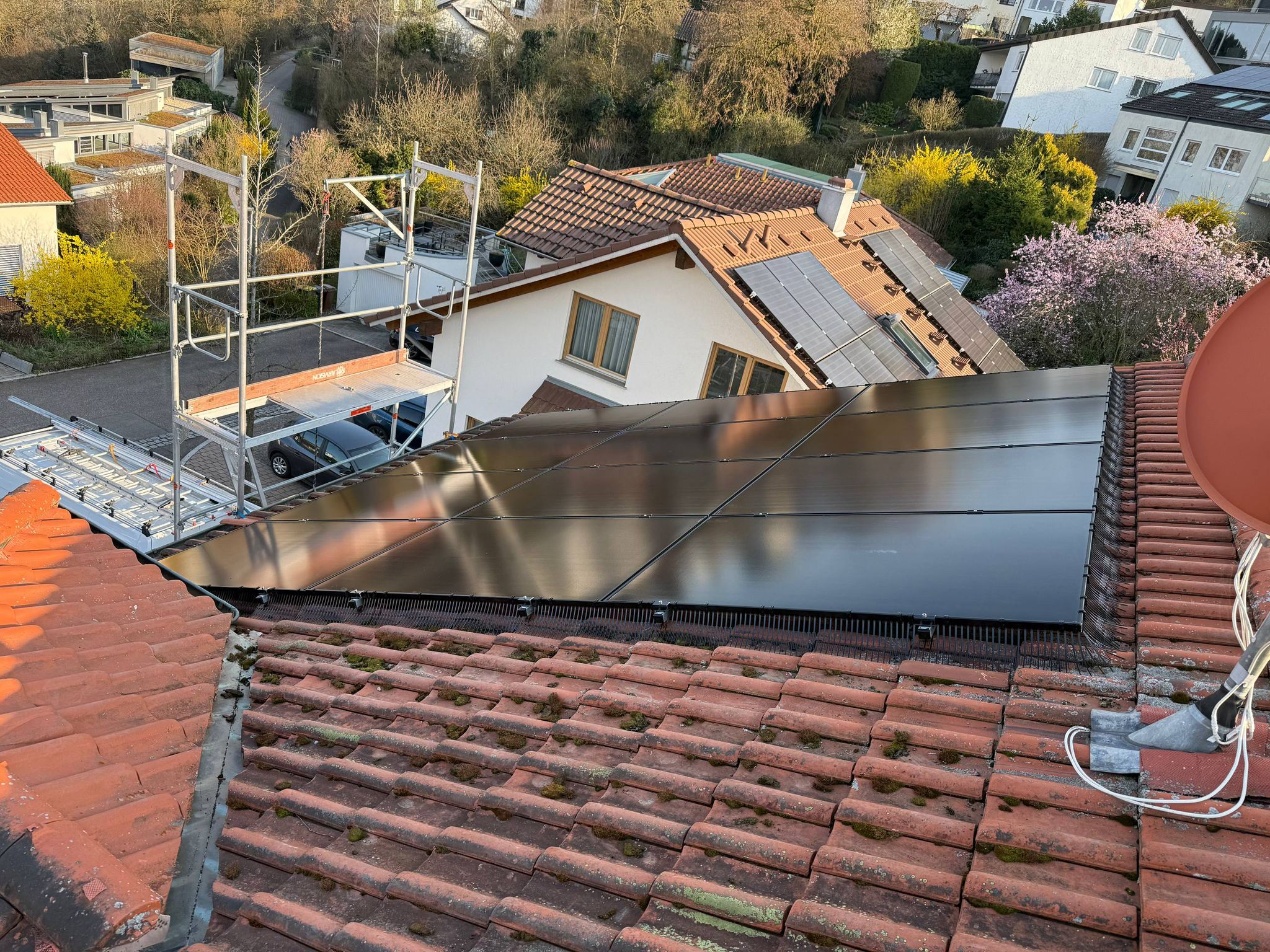
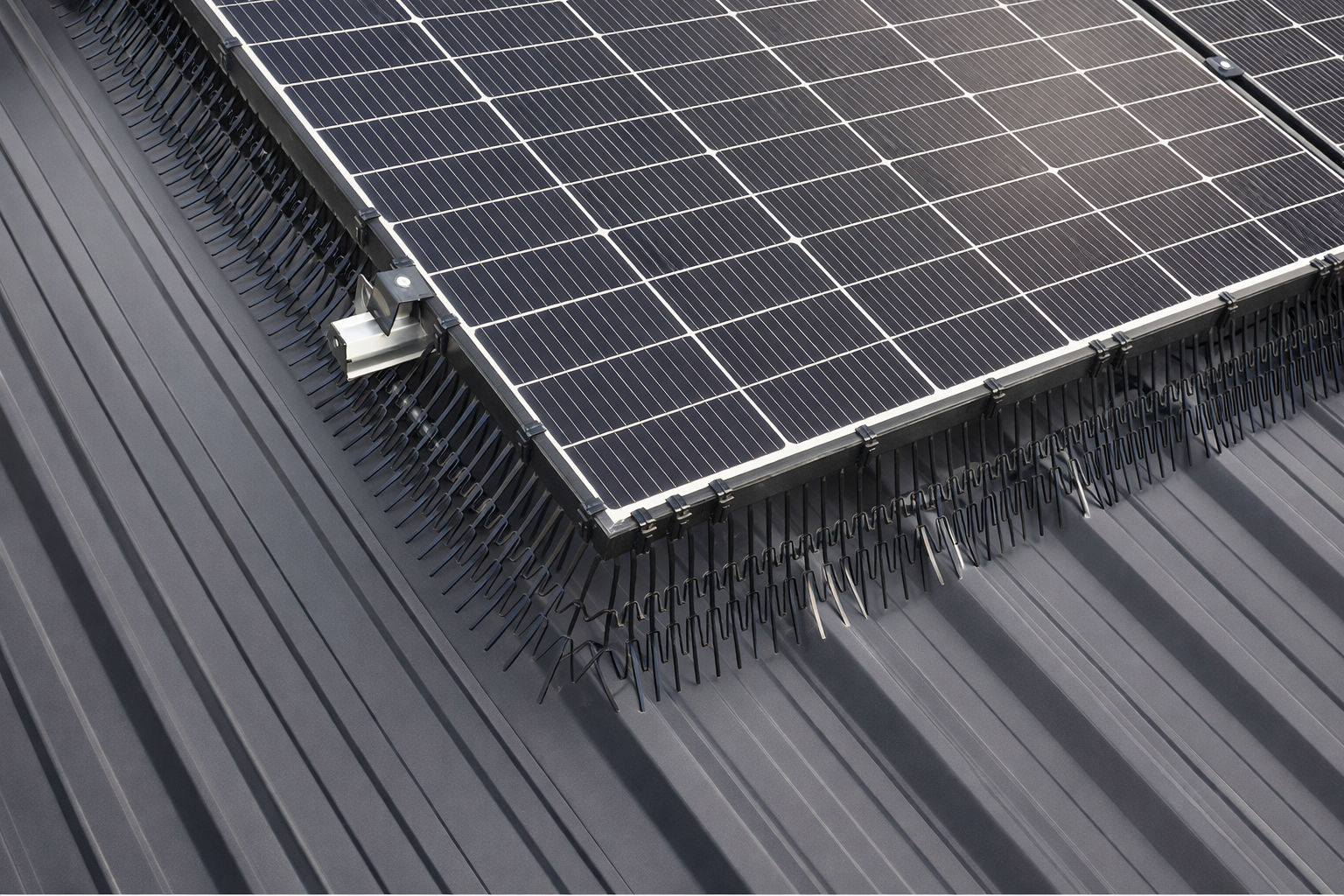
Where the diagnosis points to birds, PV Protector® closes the open edge under the modules with three engineered components.
The Perimeter Segments — HDPE with UV stabilisers 944 and 622 — seal the gap along the module perimeter and come in two heights, 150 mm (Standard) and 200 mm (Extended). C-Clips of UV-stabilised PC+ABS snap them onto module frames of 30, 35 and 40 mm, tool-free and without drilling, so nothing is done to the module that could touch its warranty. UV-stabilised PA66 Cable Ties secure the run. The system carries a 10-year warranty per the manufacturer specification and is designed exclusively for pitched roofs with a defined lower module edge.
What that changes for the cabling is straightforward: no cavity access means no nest building in the cavity, no material dragged across the runs, no debris packed against the jacket, and no annual re-accumulation to clean out. It removes one mechanism completely. It does not remove the other one — and saying so is the difference between a specification a customer can trust and one they discover the limits of the hard way.
A Diagnostic Checklist for the Next Call-Out
Six steps that turn this into a repeatable routine:
- Photograph before you touch anything — wide shot for context, close-up for the damage geometry, and note the module position. - Classify the cut. Transverse, bitten, jacket removed in a band with parallel grooves means rodent. Chafed, polished, thinned at a contact point means abrasion. - Read the residue. Small dark elongated droppings and shredded material means rodent. Feathers, twigs, straw and white-and-dark splashes mean birds. - Find the access route at the eaves, verge and any roof penetration, and record how the animal got in. - Test the insulation resistance on the affected string and the neighbouring ones before and after repair — an intermittent fault is easy to miss on a dry afternoon. - Quote the correct measure. Gnaw marks get a rodent measure; nesting evidence gets the perimeter closed; poor routing gets re-clipped either way.
Rodents under solar panels and birds under solar panels produce different marks, need different fixes and belong in different lines on a quotation. Where the evidence is avian, a pitched-roof array fitted with PV Protector® Perimeter Segments (HDPE, UV stabilisers 944 and 622), C-Clips (UV-stabilised PC+ABS for 30/35/40 mm frames) and PA66 Cable Ties removes the habitat that put the cable at risk, backed by a 10-year warranty.
To specify bird protection for your next pitched-roof project — or to discuss installer and distributor conditions — talk to the PV Protector® team.
Comments