
Does Insurance Cover Solar Panel Damage? What Unprotected Arrays Risk
"Does insurance cover solar panel damage?" is one of the first questions an owner asks after finding droppings, nesting material or chewed cable sheathing under an array — and the honest answer is: it depends on what the policy says, and on what you can prove you did to look after the system. Most policies were written around storms, hail and fire. Damage that builds up slowly under the modules, the way bird activity does, sits in a much greyer zone.
This article looks at where that grey zone is, why unprotected arrays are the ones that struggle at claim time, and how documented prevention changes the conversation with an insurer. The discussion assumes a pitched-roof photovoltaic array with a defined lower module edge — PV Protector® is engineered for pitched roofs and does not fit flat-roof ballasted systems, ground-mount or open-field PV.
What a Typical Policy Actually Covers
Rooftop PV is usually insured in one of two ways: as part of the building insurance, or through a dedicated PV policy. In Germany — Europe's largest rooftop market — the insurers' association GDV publishes model conditions for residential building insurance that explicitly list PV components such as modules, mounting structure, fastening elements, inverters and cabling within the insured building. Named perils like fire, storm and hail are the core of that cover.
Gradual damage is a different story. Soiling, corrosion, wear and damage that develops over months are commonly limited or excluded, and animal-related clauses vary widely from policy to policy: some wordings include damage caused by animal bites or nesting, many restrict it to named species, and others exclude it entirely. Recent broker feedback points the same way: whether a bird-related loss is paid often turns less on the peril and more on the policy wording and the maintenance record behind the system. The only reliable answer comes from reading the specific conditions — not from assuming the array is "insured, so it's fine".
Does Insurance Cover Solar Panel Damage From Birds and Nesting?
Bird activity damages arrays in ways that sit awkwardly across policy categories. Droppings build up and shade cells. Nesting material accumulates against the underside of the modules, holding moisture against cabling and blocking the ventilation gap. Cable sheathing gets pecked and abraded. None of this is a single insured "event" with a date and a cause — it is a slow deterioration that an adjuster can plausibly attribute to lack of maintenance rather than to an insured peril.
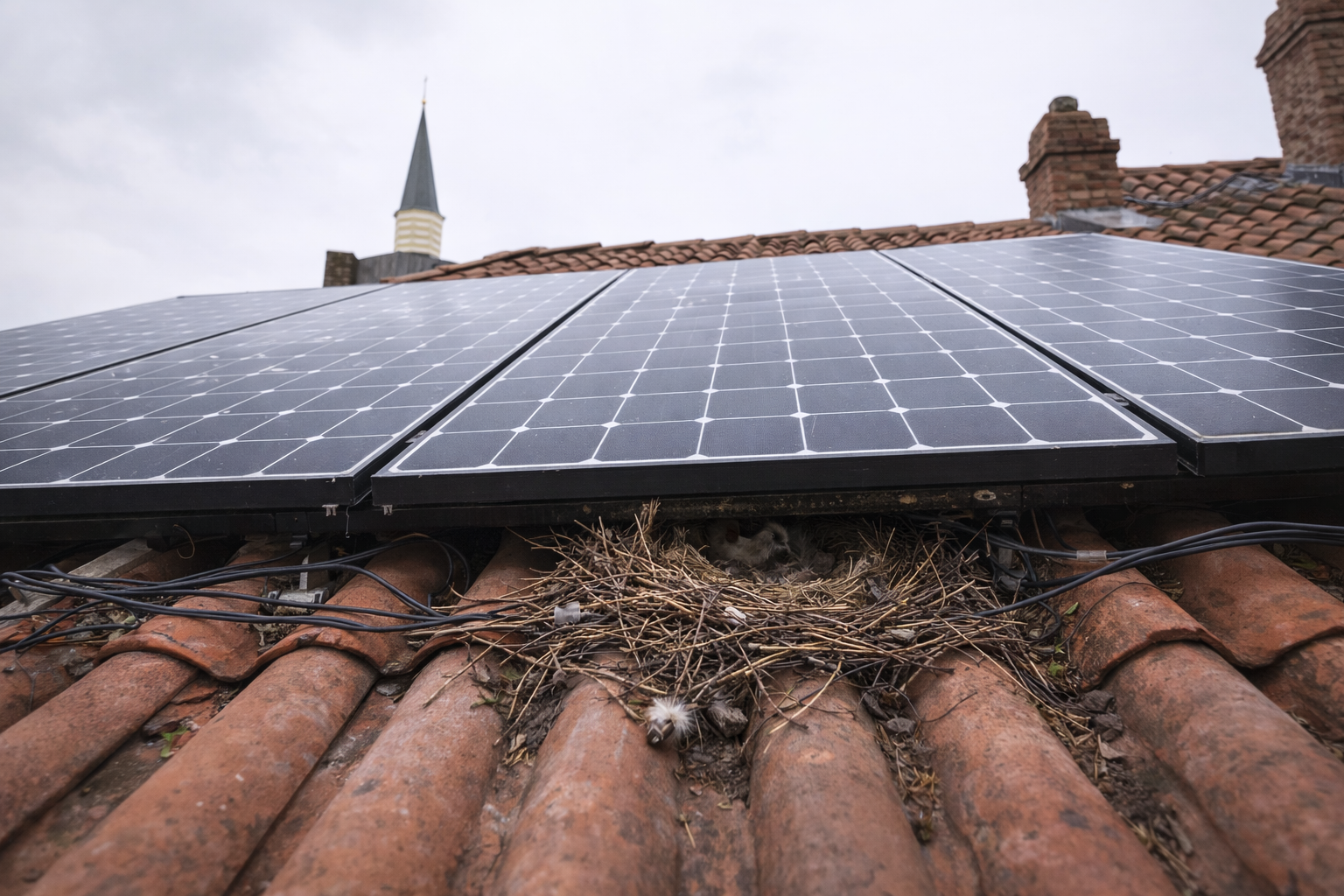
The fire scenario shows why this matters most. Nesting material under modules is combustible, and it collects exactly where DC cabling and connectors run. A multi-year German research project by TÜV Rheinland and Fraunhofer ISE — published as a guideline on fire risk in PV systems — confirmed around 210 cases in which fires were caused by the PV system itself, and concluded that the overall fire risk is low but clearly reducible through correct planning, installation and operation (Fraunhofer ISE / TÜV Rheinland fire risk guideline). An array where nesting has been left to accumulate is the opposite of "correct operation" — and the connection between nesting and fire pathways is set out in more detail in our article on bird nesting and fire risk in photovoltaic systems.
So does insurance cover solar panel damage caused by birds? Sometimes, partially, or not at all — and industry observation suggests adjusters increasingly ask for inspection and maintenance documentation when a loss involves nesting or heavy soiling. The owner who can produce dated photos and an inspection log negotiates from a very different position than the owner who cannot.
Maintenance Duties: The Clause That Decides the Claim
Most policies do not just describe perils — they impose duties on the policyholder. In German insurance contract law, for example, §28 of the Insurance Contract Act (VVG) allows an insurer to reduce or refuse payment where the policyholder breached a contractual obligation intentionally or through gross negligence. PV policy wordings routinely contain exactly such obligations: keep the system maintained, inspect it regularly, document what was done.
Other European markets structure the duty differently, but the pattern is familiar everywhere: national insurance contract law plus the policy conditions define what "looking after the system" means, and a neglected array gives the insurer arguments at precisely the moment the owner needs the policy to respond. That is the real insurance case for prevention — not that protection is required by law, but that a documented, protected array removes the neglect argument before it can be made.
What that documentation looks like in practice is covered in our solar panel maintenance checklist template: dated inspection entries, photos of the array edge and the roof area under the modules, and records of any cleaning or repairs.
Prevention as Documented Risk Reduction
This is where physical bird protection earns its place in an insurance conversation. A pitched-roof array fitted with a perimeter barrier cannot accumulate nesting material under the modules in the first place — the slow-deterioration scenario that policies handle worst simply never starts.
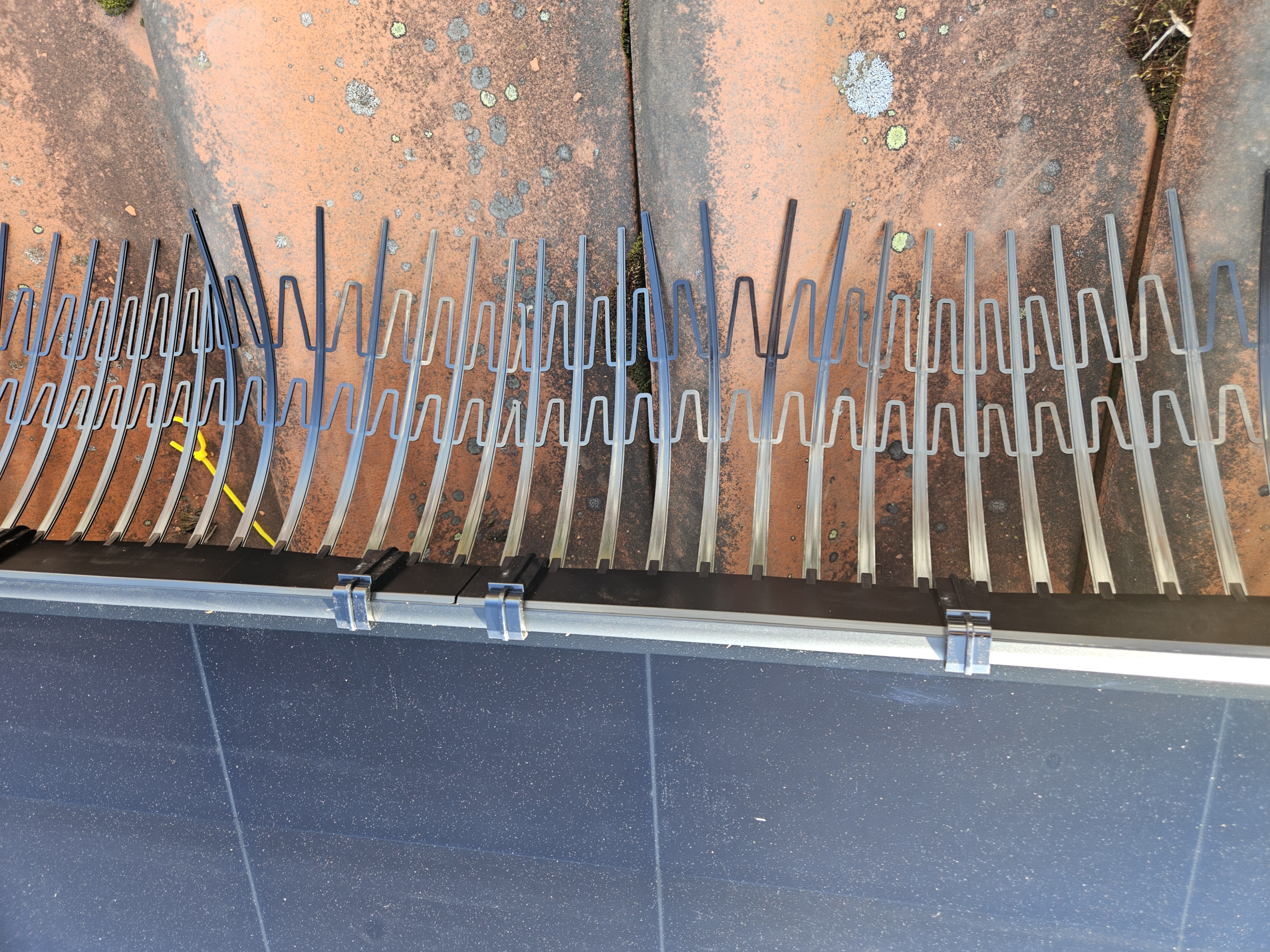
PV Protector® approaches this with three engineered components. The Perimeter Segments are made of HDPE with UV stabilisers 944 and 622 and close the gap along the module edge; they come in two heights, 150 mm (Standard) and 200 mm (Extended). The C-Clips, moulded from UV-stabilised PC+ABS, snap the Segments onto module frames of 30, 35 and 40 mm — tool-free, with no drilling into the frame and therefore no module-warranty questions. UV-stabilised PA66 Cable Ties secure the run. The system is backed by a 10-year warranty per the manufacturer specification, and it is designed exclusively for pitched roofs with a defined lower module edge.
For an insurer or adjuster, that translates into a clean story: the ventilation gap stays clear, cabling stays out of reach of nesting birds, and the installation itself is documented with photos on handover day. For the owner, it removes the maintenance costs that bird activity otherwise generates year after year — costs we quantify in the hidden maintenance costs of bird activity on rooftop PV systems.
A Practical Checklist Before You Rely on the Policy
For installers advising customers, and for owners reviewing their own cover, five steps close most of the gap between "insured" and "actually protected":
- Read the animal-damage and gradual-damage clauses. Establish in writing whether nesting, droppings and bite damage are covered, limited or excluded. - Check the maintenance obligations. Note what inspection interval and documentation the wording expects. - Document the baseline. Photograph the array — including the underside gap at the eaves edge — at commissioning or at the next service visit. - Keep an inspection log. A dated entry twice a year is a small effort against the leverage it provides in a claim discussion. - Fit physical protection on pitched-roof arrays. Prevention is the only measure on this list that removes the damage mechanism instead of arguing about it afterwards.
The Question Behind the Question
Ask "does insurance cover solar panel damage" and you get a conditional answer. Ask "will my claim survive a look at how the array was maintained" and you get a useful one. Policies respond best to sudden, documented events on well-kept systems; they respond worst to slow, preventable deterioration on neglected ones. A pitched-roof array fitted with PV Protector® Perimeter Segments (HDPE with UV stabilisers 944 and 622), C-Clips (UV-stabilised PC+ABS, for 30/35/40 mm frames) and Cable Ties (UV-stabilised PA66) — installed tool-free and backed by a 10-year warranty — keeps the damage mechanism off the roof and the neglect argument out of the claim file.
To specify bird protection for your next pitched-roof project — or to discuss installer and distributor conditions — talk to the PV Protector® team.
Comments